
LESS BUREAUCRACY, MORE RESULTS!
Entrepreneurs want to focus on running their business, not paperwork!
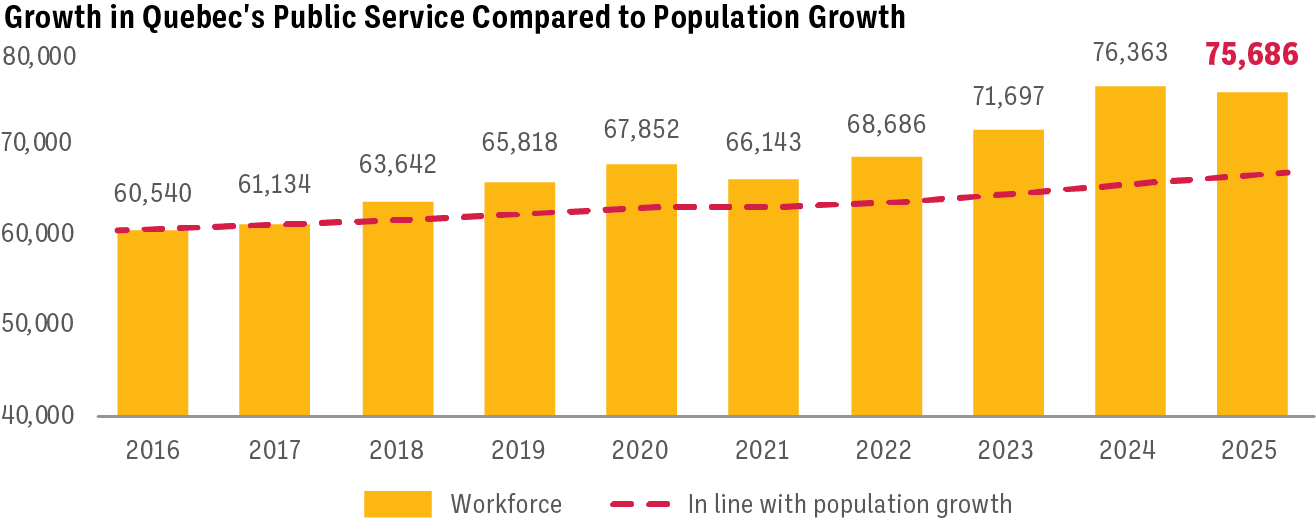
The number of public servants increased by 25% over 10 years, which is 2.5 times the rate of population growth1.

Accessibility: the public service growth chart in text format
This bar chart, titled "Growth in Quebec's Public Service Compared to Population Growth," shows the size of Quebec's public service workforce each year from 2016 to 2025. The vertical axis runs from 40,000 to 80,000.
The workforce grew from 60,540 in 2016 to 75,686 in 2025, which is highlighted in red. Its highest point was 76,363 in 2024.
A dashed red line, labelled "In line with population growth," shows how the workforce would have grown if it had kept pace with the population. The line starts at the level of the 2016 bar and rises slowly. From 2018 on, every bar is above the line, and the gap is largest in 2024 and 2025.
| Year | Workforce |
|---|---|
| 2016 | 60,540 |
| 2017 | 61,134 |
| 2018 | 63,642 |
| 2019 | 65,818 |
| 2020 | 67,852 |
| 2021 | 66,143 |
| 2022 | 68,686 |
| 2023 | 71,697 |
| 2024 | 76,363 |
| 2025 | 75,686 |
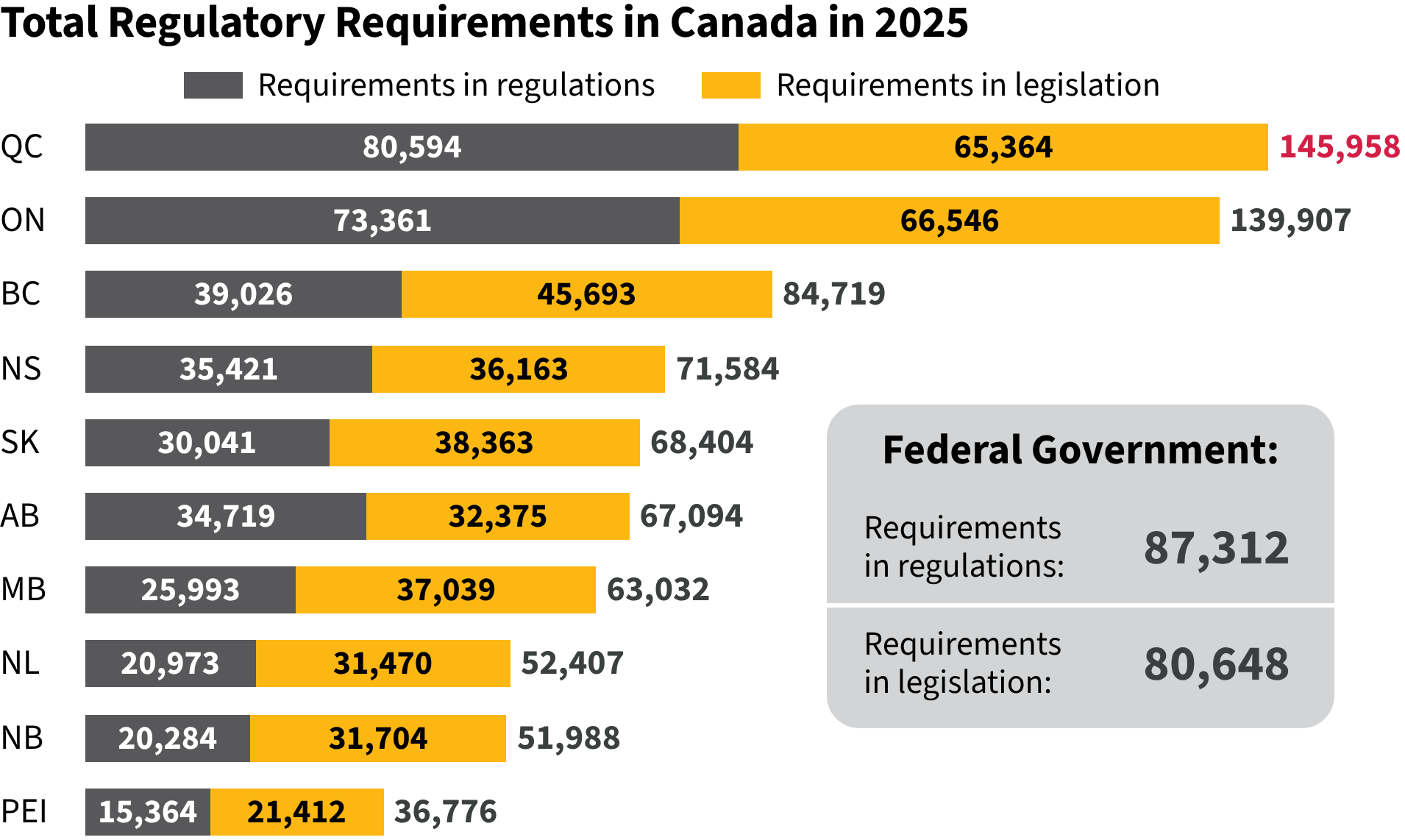
145,958 That's the number of regulatory requirements in Quebec2, far more than anywhere else in Canada!
Accessibility: the regulatory requirements chart in text format
This bar chart, titled "Total Regulatory Requirements in Canada in 2025," shows the number of regulatory requirements in each province. Each bar is split into requirements in regulations (dark grey) and requirements in legislation (yellow), with the total at the end of the bar. Quebec's total is highlighted in red.
Quebec has the most, with 145,958, followed by Ontario with 139,907. Prince Edward Island has the fewest, with 36,776.
A separate box shows the federal government's figures: 87,312 requirements in regulations and 80,648 requirements in legislation.
Regulatory requirements by province, 2025
| Province | In regulations | In legislation | Total |
|---|---|---|---|
| Quebec | 80,594 | 65,364 | 145,958 |
| Ontario | 73,361 | 66,546 | 139,907 |
| British Columbia | 39,026 | 45,693 | 84,719 |
| Nova Scotia | 35,421 | 36,163 | 71,584 |
| Saskatchewan | 30,041 | 38,363 | 68,404 |
| Alberta | 34,719 | 32,375 | 67,094 |
| Manitoba | 25,993 | 37,039 | 63,032 |
| Newfoundland and Labrador | 20,973 | 31,470 | 52,407 |
| New Brunswick | 20,284 | 31,704 | 51,988 |
| Prince Edward Island | 15,364 | 21,412 | 36,776 |
Quebec imposes 106.6% more regulatory requirements than the average of the other Canadian provinces.
To bring that level in line with the provincial average, a 52% reduction would be required.
It's time to cut red tape!
1: Secrétariat du Conseil du trésor du Québec, Effectif de la fonction publique 2019-2020; 2025-2025. Available online (in French only): https://www.quebec.ca/gouvernement/ministeres-organismes/secretariat-conseil-tresor/publications#c437278
2: CFIB, Counting Constraints: A Comprehensive Count of Canada's Regulatory Requirements (2025 Edition, 5 p. Available online: https://www.cfib-fcei.ca/hubfs/A%20Comprehensive%20Count%20of%20Canadas%20Regulatory%20Requirements%20(2025%20Edition).pdf)