


Tax Advocacy is in our DNA

CFIB was founded on a tax fight in the 1970s, when the federal government proposed increasing the small business tax rate to 50%. We stopped them then — and we’ve been fighting for tax fairness and holding governments accountable ever since. Government budgets and spending decisions directly shape your tax burden and economic environment. Whether on Parliament Hill, at provincial legislatures, or city hall, we advocate for fair, simple, and practical tax policies while demanding responsible government spending that respects your hard-earned tax dollars.
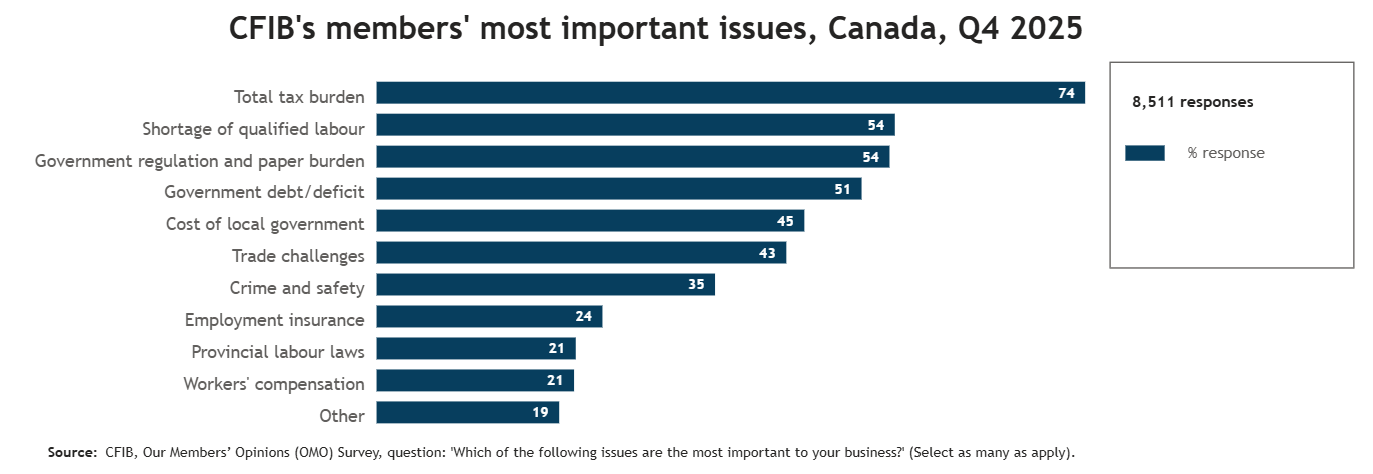

Bar chart showing CFIB members’ top issues in Canada for Q4 2025. Total tax burden ranks highest at 74%, followed by labour shortages and regulation/paper burden at 54%. Other issues include debt/deficit, local government costs, trade, crime, EI, labour laws, and workers’ compensation.

CFIB's Most Important Issues - Canada (Q4 2025)

Total tax burden74%
 
Shortage of qualified labour54%
 
Government regulation & paper burden54%
 
Government debt / deficit51%
 
Cost of local government45%
 
Trade challenges43%
 
Crime and safety35%
 
Employment insurance24%
 
Provincial labour laws21%
 
Workers' compensation21%
 
Other19%
 
Source: CFIB, Our Members' Opinions (OMO) Survey, question: "Which of the following issues are the most important to your business?" (Select as many as apply).

For small businesses, taxes aren’t just a cost - they influence day-to-day decisions and long-term growth. Factors such as tight margins, ongoing reinvestment, and complex rules mean even small changes can have a significant impact.

When members identify taxes as a priority, it shapes:

  • The issues we bring forward to governments
  • The policy solutions we develop
  • The campaigns we lead to drive change

CFIB helps small businesses by focusing on reducing the tax burden and improving the business environment by advocating for competitive small business tax rates, pushing for simpler, more practical tax systems, holding governments accountable for spending decisions that can lead to higher taxes and providing tools and guidance to help members navigate their obligations.

The result is advocacy rooted in real-world business challenges to help keep your business competitive, resilient, and positioned for growth.

Resources for Small Businesses

Tax and Budget Information

As of January 1, 2026

Key Elements of Small Business Taxation

  FED NL PEI NS NB QC ON MB SK AB BC
Small business income tax 9% 2.5% 1% 1.5% 2.5% 3.2% 3.2% 0% 1% 2% 2%
Small business income limit $500,000 $500,000 $500,000 $700,000 $500,000 $500,000 $500,000 $500,000 $600,000 $500,000 $500,000
General business income tax 15% 15% 16% 14% 14% 11.5% 11.5% 12% 12% 8% 12%
Effective employer payroll tax on a $50,000 salary - 9.91% 9.19% 10.47% 9.13% 13.26% 10.29% 9.63% 9.10% 9.08% 11.32%
CPP/QPP, employer rate - 5.53% 5.53% 5.53% 5.53% 5.95% 5.53% 5.53% 5.53% 5.53% 5.53%
EI, employer rate - 2.28% 2.28% 2.28% 2.28% 2.28% 1.78% 2.28% 2.28% 2.28% 2.28%
Current CFIB Asks to Governments

Taxes and Spending

  • Lower the small business tax rate and increase the income limit (the small business deduction amount) to $700,000, and index it to inflation moving forward.
  • Introduce lower EI premiums through a permanent targeted EI credit or by moving the employer/employee split of the costs from 60/40 to 50/50.
  • Make EI voluntary for those 65 and older and consider introducing an EI premium holiday for new, young, hires.
  • Implement a business income deduction for personal income tax filers similar to the U.S. Qualified Business Income (QBI) deduction so unincorporated businesses such as sole proprietors can retain more of their earnings.
  • Simplify navigation of the tax system (such as payroll administration) with small business owners in mind.
Canadian government building
Current CFIB Asks to Governments

Taxes and Spending

  • Commit to a fiscal anchor that will reduce the deficit and debt.
  • Implement legislated spending limits for the government outside of a global crisis.
  • Commit to undertaking meaningful internal reviews to reduce the size and cost of the public service.
  • Avoid introducing new social programs or expanding existing ones (e.g., dental care, pharmacare, daycare, etc.).
  • Sell government assets (e.g., Crown corporations, land, buildings) where it makes sense.

women in an office building on a computer representing looking at property taxes

Be part of the largest small business organization in Canada.

Join more than 103,000 successful independent businesses who benefit from personalized advice, exclusive savings and a strong voice in government.