


CFIB's Recent Advocacy Highlights
Since Parliament resumed in late September, CFIB has been busy and productive. Through meetings on Parliament Hill, committee appearances, co-organizing the Entrepreneur Caucus during Small Business Week, and our Budget 2026 advocacy campaign, we worked hard to ensure the priorities of small business owners remained front and centre in federal policy discussions.
In October alone, CFIB participated in more than 40 advocacy meetings and engagements with parliamentarians, senators, ministerial staff, senior government officials, and federal agencies. From tariffs and trade uncertainty to labour shortages, red tape, payment processing costs, and tax competitiveness, every conversation was an opportunity to bring the experiences of Canada's entrepreneurs directly to policymakers.
Small Business Week Spotlight: Entrepreneur Caucus Breakfast
One recent highlight was the Entrepreneur Caucus breakfast, held during Small Business Week.
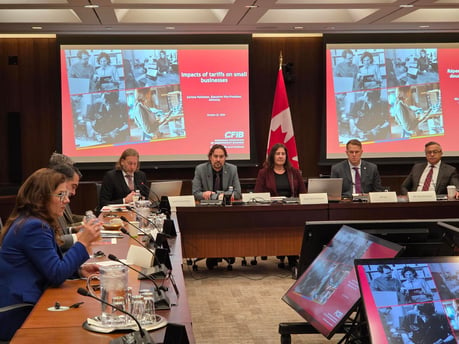

The caucus brings together parliamentarians from across party lines to hear directly about the challenges and opportunities facing Canada's entrepreneurs. The discussion focused on the impact of tariffs and trade uncertainty on small businesses and practical policy solutions to help business owners navigate an increasingly unpredictable economic environment.
Bringing Small Business Concerns to Parliament
We’ve also appeared at parliamentary committees.
On October 21, 2026, CFIB’s President and CEO Dan Kelly appeared before the House of Commons Standing Committee on Foreign Affairs and International Development during its study of the Canada-U.S. relationship. His testimony highlighted the challenges that tariff uncertainty and cross-border trade disruptions continue to create for small businesses and underscored the importance of stable and predictable trading conditions.
On October 29, 2026, CFIB’s Vice-President of National Affairs Jasmin Guénette appeared before the House of Commons' Standing Committee on Citizenship and Immigration as part of its study on attracting and empowering global talent to strengthen Canada's economy. He emphasized the labour challenges facing small firms and the need for immigration policies that better reflect the realities of Canada's small business sector.
On November 2, 2026, CFIB’s Vice-President of National Affairs Jasmin Guénette appeared before the Senate’s National Finance Committee as part of its study of Bill C-31 (Budget 2025). He highlighted the perspectives of small business owners and advocated for measures that strengthen entrepreneurship, competitiveness, and economic growth.
CFIB is also scheduled to appear at the Senate special committee on Bill C-39 at the end of November.
Putting Small Business Priorities on the Budget 2026 Agenda
CFIB did a lot of advocacy leading up to Budget 2026.
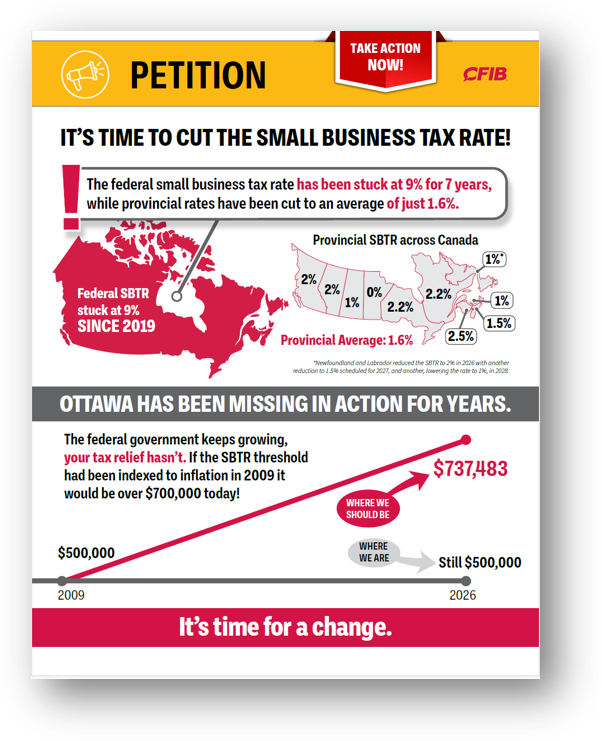
We conducted and released the results of a fiscal policy survey highlighting small business owners' views on taxation, government spending, and fiscal priorities. We also launched a series of short videos highlighting CFIB's key Budget 2026 recommendations, including reducing the federal small business tax rate from 9% to 6%, increasing the small business deduction threshold, and simplifying tax rules to encourage investment and improve competitiveness.
CFIB also joined other leading business organizations in a statement calling on the federal government to use Budget 2026 to modernize Canada's tax system, strengthen investment, improve productivity, and enhance the country's competitiveness.
To top it off, we also published an op-ed on priorities for the Federal Budget 2026.
Our advocacy efforts continue to build momentum. Thanks to the support of business owners across the country, more than 14,000 signatures have been collected to date through CFIB's petition to cut the small business tax rate, helping amplify the call for policies that reduce costs, encourage investment, and support small business growth.
We did not get what we wanted from the fall federal budget. There was the reannouncement of the Mega Deduction and enhanced rollover mechanisms as well as measures that build on earlier announcements to reduce the red tape burden by $2 for every $1 of new regulatory costs that will be beneficial for small firms and the economy as a whole. The new Canadian Growth Incentive (CGI) contains a promising $15 million capital gains exemption, which if properly designed, could be a significant catalyst for investments in small businesses
But unfortunately, there was no progress on the small business tax rate or the small business deduction threshold. If you are a small business owner struggling to keep your business going in the face of rapidly rising costs and a trade war, the budget did not provide any help whatsoever.
To learn more about our full reaction, read our media release: https://www.cfib-fcei.ca/en/media/2026-federal-budget-is-mega-disappointing-for-canadian-small-businesses
Looking Ahead
Whether through meetings with policymakers, parliamentary committee appearances, public awareness campaigns, or grassroots advocacy, CFIB remains focused on one goal: ensuring the voice of small business is heard in Ottawa.
As Parliament's work continues this fall, we will keep advocating for practical solutions that reduce costs, cut red tape, address labour shortages, improve competitiveness, and give entrepreneurs the confidence to invest, hire, and grow.
We will continue to prioritize the reduction of the small business tax rate and the increase of the small business deduction threshold as key tax policy measures that will bring relief to many small firms across all sectors and all regions.
Share this Article:

 Print Article
 Share Article
