




Summary
- More than half of small businesses are engaging with AI, either by integrating it into their processes (21%), or by exploring the technology (33%).
- AI adoption is highest among knowledge-intensive sectors and larger firms. Professional services, arts and information, and finance report the highest adoption rates, with uptake increasing as firm size grows.
- Most businesses (72%) that have adopted AI report no workforce changes, and for the rest AI is affecting tasks more than jobs. The pattern holds for entry-level jobs.
- Most businesses expect limited workforce impacts from AI over the next year, with employee reassignment emerging as the most commonly anticipated change.
Most small businesses are engaging with AI
According to CFIB's August 2026 Your Voice survey1, AI is gaining traction among Canada’s small businesses. More than half of businesses (54%) are engaging with AI (Figure 1). The level of engagement varies considerably. One in five businesses (21%) have adopted AI, of which only 1% report integrating AI across most or all operations, while most use it only in some processes (20%). Another one-third (33%) are currently exploring the technology. Although more than a quarter of businesses (28%) are not yet considering AI as a business tool, most (68%) are using, exploring or considering future applications of the technology.
Figure 1: Most businesses are are engaging with AI, though implementation remains limited
Currently, how would you describe your business's use of Artificial Intelligence (AI)?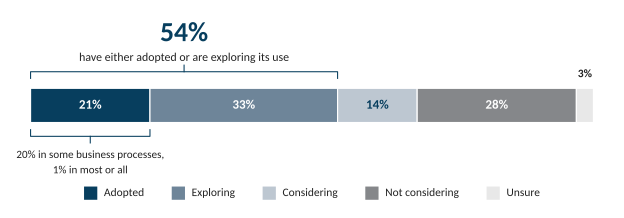
Source: CFIB, Your Voice Survey, August 18-August 31, 2026, n = 1,550.
AI exploration exceeds implementation across industries
AI engagement is highest across knowledge-intensive sectors. About three-quarters of businesses in Finance, Insurance, Real Estate and Leasing (74%), Arts and Information (73%), and Professional Services (72%) have either adopted or are exploring the technology (Figure 2). In contrast, engagement is lowest in Agriculture (51%), Administrative Management (45%) and Personal Services (42%).
The form of this engagement varies considerably between adoption and exploration. In the most engaged sectors, adoption is already well established, with approximately one-third of businesses in Finance (34%), Professional Services (34%), and Arts and Information (31%) having integrated AI into at least some business processes. In other sectors, engagement consists primarily of exploration. In Manufacturing, 40% of businesses are exploring AI compared with 18% that have adopted it, with similar patterns in Wholesale (32% vs. 25%) and Transportation (31% vs. 23%). Exploration exceeds adoption in nearly every industry, indicating that AI engagement among most businesses remains at an early stage.
Figure 2: Most industries have entered the exploration phase with AI tools
Currently, how would you describe your business's use of Artificial Intelligence (AI)?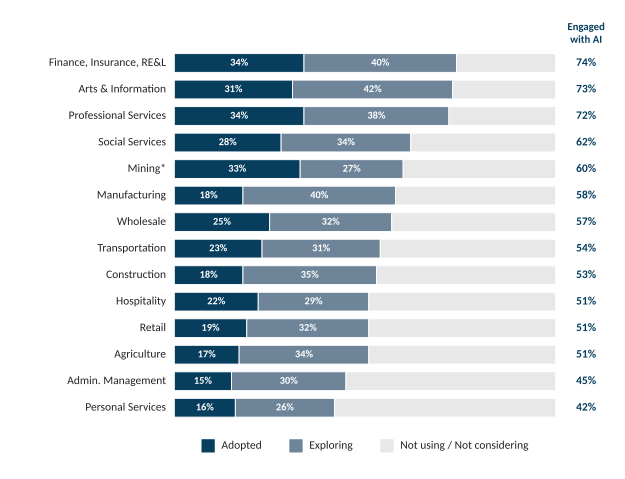
*Small sample size, n<20, interpret with caution
Sources: CFIB, Your Voice Survey, August 18-August 31, 2026, n = 1,550.
Notes: “Adopted” combines “most or all” and “some” business processes.
Engagement with AI increases steadily with business size
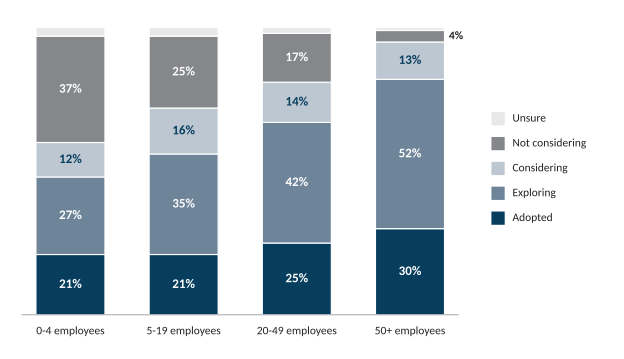
Business size is strongly associated with AI engagement. More than one-third (37%) of microbusinesses (0-4 employees) are not considering AI, while only 4% of businesses with more than 50 employees report the same (Figure 3). The difference is driven by the higher levels of exploration and integration among larger firms. More than half (52%) of businesses with more than 50 employees are exploring or testing AI solutions, compared to 27% for microbusinesses. Adoption also increases with firm size, although more gradually, rising from 21% among microbusinesses to 30% among firms with more than 50 employees.
The results suggest that larger firms are generally further along the AI adoption journey. Previous CFIB research identified limited digital skills (51%), time constraints (49%), and setup and investment costs (48%) as key barriers to technology adoption. Since these constraints are often more acute for smaller businesses, they may help explain the lower levels of AI engagement observed among smaller businesses.
Figure 3: Businesses with larger workforces are more likely to adopt and explore AI
Currently, how would you describe your businesses' use of Artificial Intelligence (AI)?
Sources: CFIB, Your Voice Survey, August 18-August 31, 2026, n = 1,550.
Note: “Adopted” combines “most or all” and “some” business processes. “Don’t know” (3%, 3%, 2%, 1%) is unlabelled.
Most businesses report no workforce impacts from AI
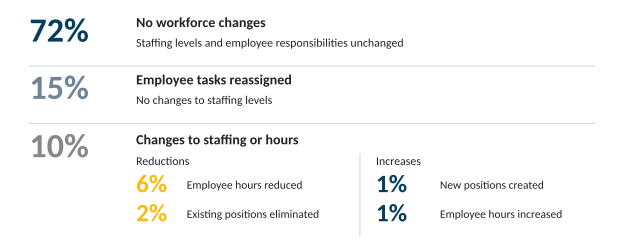
Among businesses that have integrated or explored AI, most report little impact on their workforce. Nearly three-quarters (72%) report no changes to staffing levels, employee responsibilities, or hours worked over the past 12 months (Figure 4).
Where impacts are reported, they are more likely to involve changes in employee responsibilities rather than staffing levels. Fifteen percent report reassigning employees to different tasks, while maintaining staffing levels. By comparison, one in ten businesses report changes to staffing or hours. These changes are more often reductions than increases: 6% have reduced employee hours and 2% have eliminated positions, while just 1% have created new positions and 1% have increased hours.
This pattern is consistent with Statistics Canada research suggesting that AI exposure is currently more likely to alter the nature of tasks performed than eliminate jobs altogether.
Figure 4: Changes in employee tasks are more common than changes in staffing levels
Over the past 12 months, how has AI affected staffing in your business?
Sources: CFIB, Your Voice Survey, August 18-August 31, 2026, n = 852.
Notes: Only includes businesses reporting that they are adopting or exploring AI. Don’t Know/Unsure, not displayed on the figure (6%). Percentages do not sum to 100 because respondents could select more than one option.
“Overall, AI has supplemented existing roles rather than replaced them, allowing employees to spend more time on higher-value activities such as production oversight, quality, problem-solving, and continuous improvement.”
— Manufacturing, 20-49 employees, Ontario
“Staffing wise, AI has not changed roles, or responsibilities at all at this point”
— Agriculture, 5-19 employees, Ontario
A similar pattern emerges for entry-level roles. Among businesses with entry-level positions, the vast majority (85%) stated that AI has had no impact on these roles over the past 12 months (Figure 5). Where impacts are reported, they are more likely to involve changes in job responsibilities than staffing levels. Seven percent of businesses report changes to the nature of entry-level work, while 4% report fewer entry-level roles. Only small shares report creating new types of entry-level roles (2%) or increasing the number of existing positions (less than 1%). Overall, the findings point to limited effects on entry-level employment to date.
Figure 5: Changes to job responsibilities are the largest impact on entry-level roles
Over the past 12 months, how has AI affected entry-level/junior roles in your business? 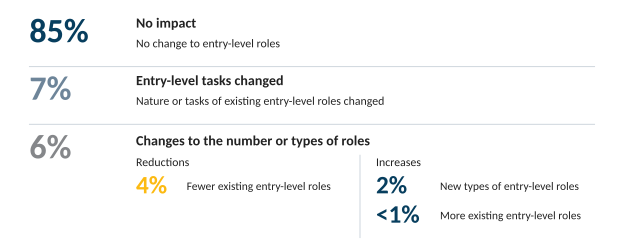
Sources: CFIB, Your Voice Survey, August 18-August 31, 2026, n = 695.
Note: Only includes businesses reporting that they are adopting or exploring AI and that they have entry-level roles (82% of AI adopters/explorers).
“There are a few projects that were not given to employees or contractors because AI was faster. My employees who are interested and trying AI are the ones I'm most interested in investing in, they are curious and trying new things.”
— Arts, recreation and information, 5-19 employees, Alberta
Looking ahead, over the next 12 months, businesses are more likely to anticipate AI changing how work is performed than staffing levels. More than four in ten businesses (43%) anticipate no workforce impacts from AI, while a further 28% say it is too early to tell. Among businesses expecting changes, employee reassignment is by far the most common impact, with 16% anticipating workers will be reassigned to different tasks without changes to staffing levels.
Conclusion
Artificial intelligence is beginning to play a role in how many small businesses operate, although adoption remains uneven across sectors and firm sizes. Both current and expected workforce impacts are concentrated more on changing employee responsibilities than staffing levels. Cost, skills, and resource constraints continue to slow adoption, particularly among smaller firms. To help address these barriers, CFIB recommends the following:
Recommendations
- Raise awareness about available government programs and incentives for digital and AI adoption.
- Provide tax relief (e.g., reductions in corporate and payroll taxes) to give SMEs the financial space to invest in technology and training.
- Offer accessible guidance to help SMEs understand how AI and other digital technologies can support their business goals—through simplified resources, success stories, and sector-specific examples.
- Monitor and encourage AI and new technology skills development across Canada to ensure a better fit between jobseekers and employers in an age of digital transformation.