




AI is reshaping how firms operate, raising questions about how businesses invest in their workforce as these technologies are adopted. This blog shows that Canadian businesses investing in AI are more likely to invest in employee training, aligning AI adoption with ongoing investment in skills.
Summary
- AI adoption is rising: Nearly 45% of Canadian businesses use GenAI in their operations, increasing sharply with firm size.
- AI is creating additional skill needs: Businesses that invest in AI are 5.4 percentage points more likely to invest in employee training.
- People remain the priority: Nearly 8 in 10 businesses plan to maintain or increase training spending in 2026.
Artificial intelligence (AI)1 is rapidly reshaping how businesses operate, from production lines to everyday decision-making. Generative AI, for instance, can significantly boost productivity: SMEs using such tools gain more than twice the time they invest each day─an average of 2.05 hours gained versus 0.97 spent.2
Debate over AI’s impact on jobs has intensified. Some warn that AI will replace workers, while others argue that AI is more likely to complement human labour by sparking new roles, enhancing productivity, and driving greater investment in people through reskilling and upskilling.
Headlines about job cuts at major companies such as Amazon3 and Dow4 have only intensified the debate over whether AI is displacing workers or reinforcing the value of human expertise. To date, however, evidence points to limited near-term employment disruption rather than broad workforce contraction. Recent data from Statistics Canada (August 2025) show that most businesses expect little immediate change to employment levels over the next 12 months, with nearly 70% anticipating no impact from AI, while expectations from job losses (12%) modestly exceed expectations of job gains (7%) nationally.5 This suggests selective or incremental workforce trimming rather than widespread displacement.
To examine the other side of the debate, this blog explores whether AI adoption among Canadian businesses is linked to increased investment in employee training. Specifically, it examines how Canadian business owners are approaching employee training in the era of AI, comparing businesses that invest in AI with those that do not. Our analysis draws on findings from two CFIB surveys: Digital Technology and AI Adoption (Q2 2025) and the Your Voice Survey (February 2026).
AI use and AI investment rise together as firm size increases
AI adoption is becoming increasingly common among Canadian businesses, but its uptake varies sharply by firm size. Nationally, 45% of businesses report using GenAI to complete tasks, and this share rises steadily with size: from 39% among businesses with fewer than five employees to 60% and above among those with 20-49 (Figure 1). This upward trajectory continues among larger firms.
A similar pattern emerges for investment in AI6. While 47% of businesses overall say they are investing in AI, only 42% of the smallest businesses do so, compared with 62% among those with 20-49 employees─with this upward trend continuing for larger employers.
Figure 1: AI usage and investment scale up consistently with business size
-4.png?width=980&height=600&name=Untitled%20design%20(2)-4.png)
Question: In 2026 does your business intend to do more or less of the following compared to 2025? (Select one for each line) | Investments in AI enabled technology and equipment Includes businesses planning to invest less, the same, or more, with unsure respondents removed. Looking back, how would you describe 2025 for your business in terms of revenues, profits and sales? (Select one)
Question: On average, how often does your business use Generative AI to complete tasks? (Select one). Includes all businesses using Generative AI at least annually; “don’t know/unsure” responses were removed.
Sources: CFIB, Survey on digital technology and AI adoption, April 24 - June 6, 2025, n= 1,683. CFIB, Your Voice Survey - February 2026, February 5 - Feb. 25, 2026, n= 1,379.
Note: * Small sample size (less than 40 responses)
Taken together, these patterns suggest that AI use and AI investment move hand in hand. Businesses that adopt AI are generally also committing resources to it, indicating that adoption is typically part of a deliberate investment strategy rather than a casual or opportunistic choice. The notable exception is among the largest businesses, where AI use significantly outpaces investment, suggesting these businesses may rely heavily on existing tools or subscription-based services rather than new capital spending.
Beyond firm size, adoption patterns also vary meaningfully across sectors. Professional services, information, and finance industries lead in both AI use and investment, while goods-producing and consumer-facing sectors tend to lag. In a few sectors such as social services, enterprise and administrative management, AI use exceeds investment, indicating low-cost adoption paths. By contrast, hospitality stands out as investing ahead of usage, suggesting early rollout rather than full deployment.
Investment in people remains a priority for businesses in 2026
As seen previously, Canadian business owners tend to adopt and invest in AI in tandem as businesses grow, and figure 2 refines how those intentions translate into 2026 budgets. The data points to a two-track story.
First, employee training stands out as the most resilient line item, with 78% of businesses planning to maintain or increase spending training in 2026.
Second, technology spending is more segmented. For job or process automation 61% plan to spend the same or more, with 37% reporting no plans to invest. Non-AI technology shows a similar pattern, with 61% planning to maintain or increase spending, with 32% reporting no planned investment.
Figure 2: Training dominates 2026 investment plans, while AI investment remains split
-2.png?width=950&height=582&name=Untitled%20design%20(3)-2.png)
Question: Compared to 2025, does your business intend to do more or less of each of the following in 2026? (Select one for each line). “don’t know/unsure” responses were removed.
Source: CFIB, Your Voice February 2026 surveys, n=1,379.
Note: In some instances, responses may not add up to 100% due to rounding.
Artificial intelligence is the most polarized category: it has the highest share planning to increase spending at 27%, yet a majority of businesses, 52%, report no plans, and only 19% expect to keep AI spending unchanged. In other words, many businesses remain on the sidelines for AI, but among those that intend to act, the likelihood is toward expansion rather than scaling back. Taken together, the picture is one in which business owners continue to prioritize investment in people while approaching technology more selectively, with AI positioned for growth within a smaller but decisive subset of businesses. What this analysis does not tell us, however, is whether businesses that plan to invest in AI behave differently from those that do not when it comes to investing in their employees’ training.
Do AI-investing firms behave differently with respect to training?
These patterns describe overall investment priorities, but they do not tell us whether AI adopting businesses behave differently from others when it comes to workforce training.
To assess this we move beyond aggregate trends and compare businesses that invest in AI with those that do not by examining their likelihood of investing in employee training.7 The analysis accounts for basic differences between businesses—such as size, sector, and location—so the comparison reflects more than just who is bigger or more established.
Figure 3 shows that businesses investing in AI are 5.4 percentage points more likely to invest in employee training than businesses that do not. While the findings do not distinguish between types of training, they do indicate that AI adopting businesses tend to rely on developing their workforce to support new technologies.8
Figure 3: Canadian businesses that invest in AI are 5.4 percentage points more likely to invest in employee training.
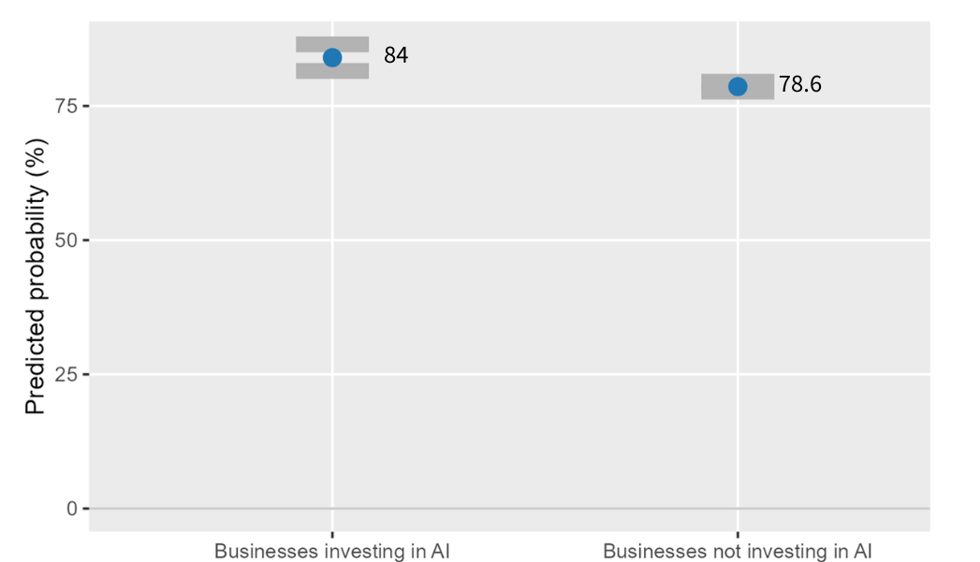
Source: Authors’ calculations based on CFIB, Your Voice February 2026 surveys, n=1,379.
Notes: The figure presents adjusted predicted probabilities from a binary probit regression of businesses’ investment in employee training on AI investment. The model includes controls for firm size, automation investment, nonAI technology investment and years in business, as well as fixed effects for province and sector. Predicted values are obtained through marginal standardization by comparing each firm under two scenarios, AI = 0 and AI = 1, while holding all other characteristics constant. Confidence intervals correspond to 90 percent cluster-robust standard errors at the province level. Estimates are based on cross-sectional survey data from 1,186 CFIB members who are Canadian independent businesses.
Conclusion
This analysis speaks directly to the debate over whether AI adoption leads businesses to invest more deeply in their workforce. Our findings show that businesses adopting AI are more likely to invest in employee training, pointing a complimentary relationship between technology adoption and workforce development. Many firms appear to be strengthening workplace skills as they integrate new tools, prepare to scale, or build complementary human capabilities.
Overall, the current effect of AI on workforce investment is positive, though this may evolve as technologies mature and become more embedded in daily operations. For now, AI investment and workforce development are moving together.
To help small businesses continue investing with confidence, governments can:
- Reduce cost pressures to encourage reinvestment: Lower taxes, fees, and compliance costs so businesses have the financial room to modernize and invest in productivity improvements.
- Support skills development to strengthen capacity: Offer accessible guidance to help SMEs understand how AI and other digital technologies can support their business goals—through simplified resources, success stories, and sector-specific examples.
- Streamline regulations to make modernization easier
Cut red tape and reduce administrative burden, enabling firms to upgrade systems and invest more confidently.