

Latest Research
Open For Business: Canada’s 2026 Municipal Report Card
Small businesses are the heart of vibrant, thriving communities, and across Canada, municipalities are taking different approaches to supporting them. However, while some create strong conditions for entrepreneurship, others continue to present challenges.
CFIB’s 2026 Municipal Report Card evaluates 66 municipalities across Canada to identify which communities are creating the best environment for small businesses. The first edition grades municipalities in three key areas:
-
Cost burden
-
Regulatory burden
-
Small business friendliness
The results show that there is significant room for improvement, with more than half of the municipalities receiving a failing grade. The report highlights leading municipalities and best practices, while identifying opportunities for governments to create a more competitive and business-friendly environment.
Breaking ground: A jurisdictional update on housing initiatives to reduce red tape
Canada is facing a housing shortage and reducing red tape in the construction process is one way to help combat the shortage. CFIB's 2024 report, Flushing Out the Nonsense, examined the permits, costs, and requirements involved in converting a simple powder room into a full bathroom across 12 Canadian municipalities, highlighting both best practices and areas for improvement.
CFIB’s 2025 report builds on the 2024 report by providing a comprehensive scan of the actions taken by federal, provincial, and municipal governments to reduce housing-related red tape since the release of the original report.
*Note: A link to 2024 Flushing Out the Nonsense, can be found on the 2025 Breaking ground report page.

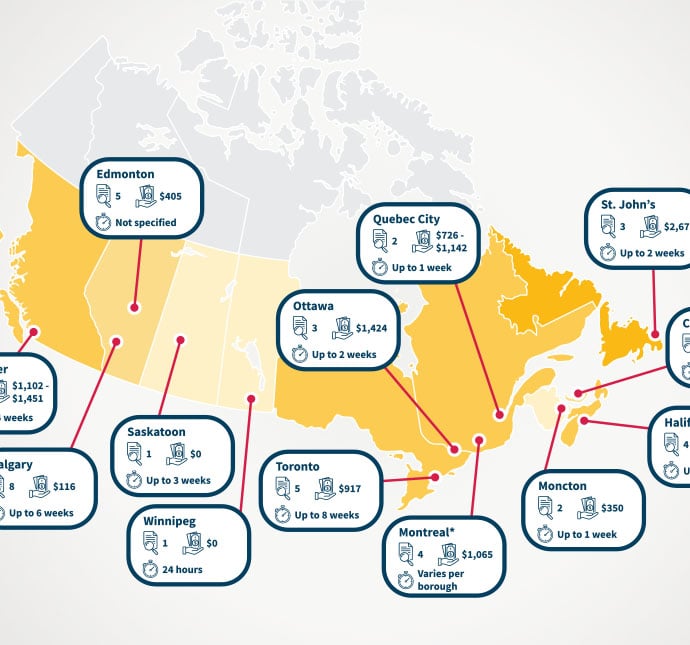
Free in Winnipeg, an arm and a leg in St. John’s: Patio permit costs vary greatly across Canada
Outdoor patios can provide a valuable source of revenue for restaurants, bars, and other hospitality businesses, helping them attract customers and make the most of the warmer months. However, the costs, fees, and administrative requirements associated with patio permits vary significantly across Canada, creating unnecessary barriers for businesses in some parts of the country.
In this research piece, CFIB compares patio regulations and permitting processes across 13 different Canadian municipalities, highlighting which local governments are making it easier for businesses to operate and which are not.
Hard hats and hard times: Public construction impacts on small businesses
As municipalities continue to invest in much-needed public infrastructure improvements, small businesses are often left to bear the unintended consequences. Prolonged disruptions and persistent noise, restrictions to business access, and debris severely impact businesses’ foot traffic, sales, and operations.
CFIB’s report examines the growing burden public construction projects place on small and medium-sized businesses, evaluating existing mitigation measures, and identifies gaps in government policy. It also offers practical recommendations to help governments better balance infrastructure improvements with the needs of the businesses that keep local economies vibrant.