




Amid an ongoing entrepreneurial drought and persistently high operating costs, new survey results show how tariff pressures from the U.S.-Canada trade war affected business performance in 2025, and where governments should focus their support.
Summary
- Small businesses entered 2025 already under strain from persistently high costs and slowing business dynamism.
- Tariff pressures linked to the U.S.-Canada trade war further intensified small business challenges.
- Survey results from over 1,600 business owners show divides between firms hit by trade impacts and those that weren’t.
- Broad-based policy measures, not just targeted tariff relief, will be critical to securing stability and reversing the slowdown in entrepreneurial momentum.
Small businesses across Canada spent much of 2025 navigating a tough and unpredictable economic environment. Escalating tariff pressures and persistent U.S.–Canada trade tensions, layered on top of high operating costs intensified economic uncertainty and complicated planning for businesses.
These pressures are also unfolding against a backdrop of weakening business dynamism. Canada’s entrepreneurial drought began well before 2025: business entries have slowed since mid-2022, while exits have been rising steadily from mid-2021, and net business creation is now negative, with the gap widening each quarter.1
To understand how the day-to-day challenges of running a business, combined with an uncertain and increasingly difficult business environment, have shaped small businesses’ performance in 2025, CFIB included a series of questions in our December Your Voice Omnibus survey. The survey received more than 1,600 responses from independent business owners across Canada.2 Their responses offer a clear, firsthand view of how these pressures shaped their bottom line in 2025 and suggest where government support could make the greatest difference.
2025: A mixed year for business performance
Survey results reveal varied outcomes for small businesses across revenues, profits, and sales. While an “average” year was the most common single response (28%), the combined share of businesses reporting either a good (37%) or poor year (35%) was higher and nearly evenly split, highlighting how divided business conditions were across the country in 2025 (Figure 1).
Figure 1: 2025 Small business performance
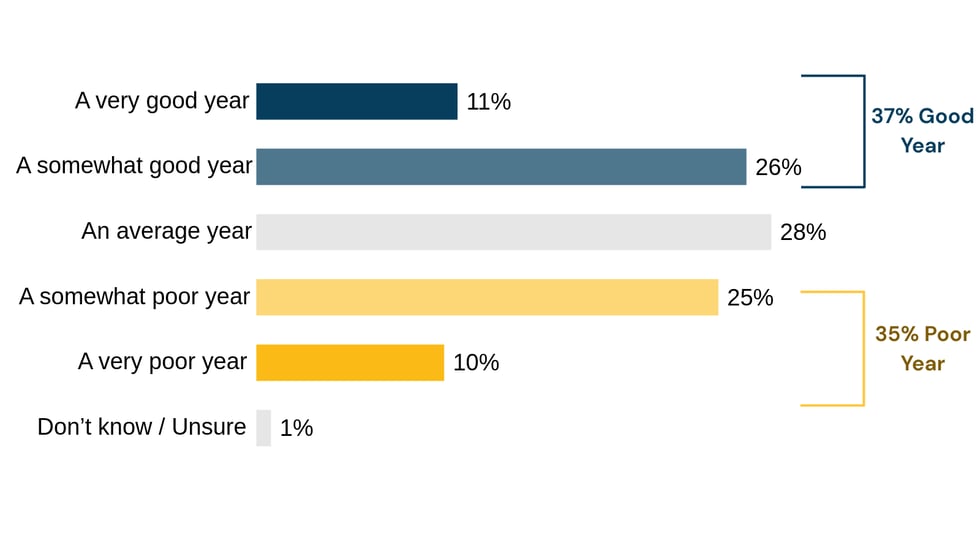
Question: Looking back, how would you describe 2025 for your business in terms of revenues, profits and sales? (Select one)
Source: CFIB, Your Voice – December 2025 survey, December 4 - 31, 2025, n=1,664.
Smaller firms felt the most pressure
Smaller businesses were less likely to report having a good year compared to larger firms. For example, only 35% of firms with 0–4 employees reported a good year versus 42% of those with 50–99 employees, reflecting the tighter margins and limited buffers that make smaller businesses more vulnerable to rising costs and sudden disruptions (Figure 2).
Figure 2: 2025 Small business performance by business size
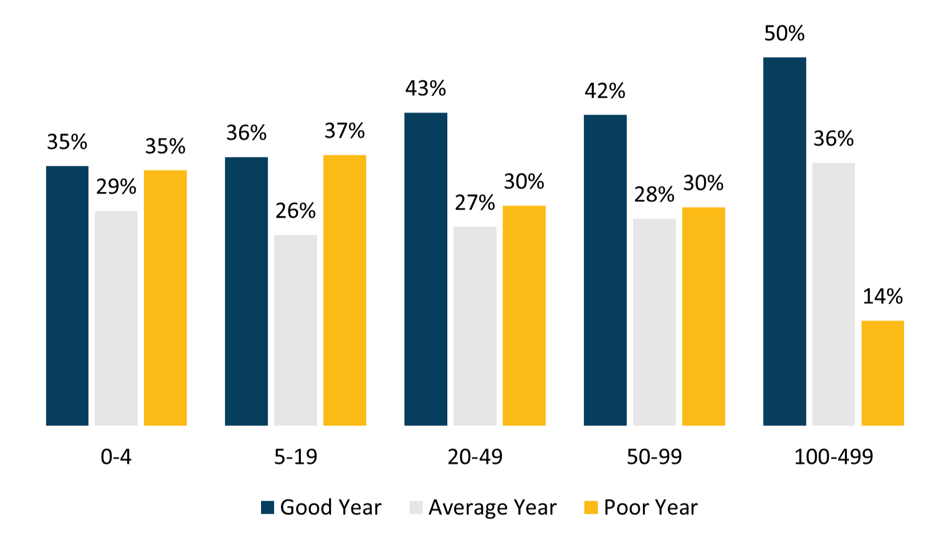
Question: Looking back, how would you describe 2025 for your business in terms of revenues, profits and sales? (Select one)
Source: CFIB, Your Voice – December 2025 survey, December 4 - 31, 2025, n=1,664.
Note: *Small sample size (<40).
Tariff impacts drive the performance gaps
Across all businesses the likelihood of having a poor year is strongly tied to whether they were hit by tariff‑related impacts. Only 7% of firms that had a poor year reported no tariff‑related impacts, compared with 16% and 22% of those reporting an average or good year respectively.
Figure 3 shows why this link is so strong. Businesses having a poor year face a higher level of nearly every Canada-U.S. trade war impact. Of note, nearly a third (31%) of businesses experiencing a poor year say they have taken on increased debt compared with just 10% and 5% of those having average or good year respectively. Poor performing businesses also experienced much higher levels of reduced hiring and paused investments.
Figure 3: Top impacts of the U.S.-Canada trade war on small businesses by business performance (%)
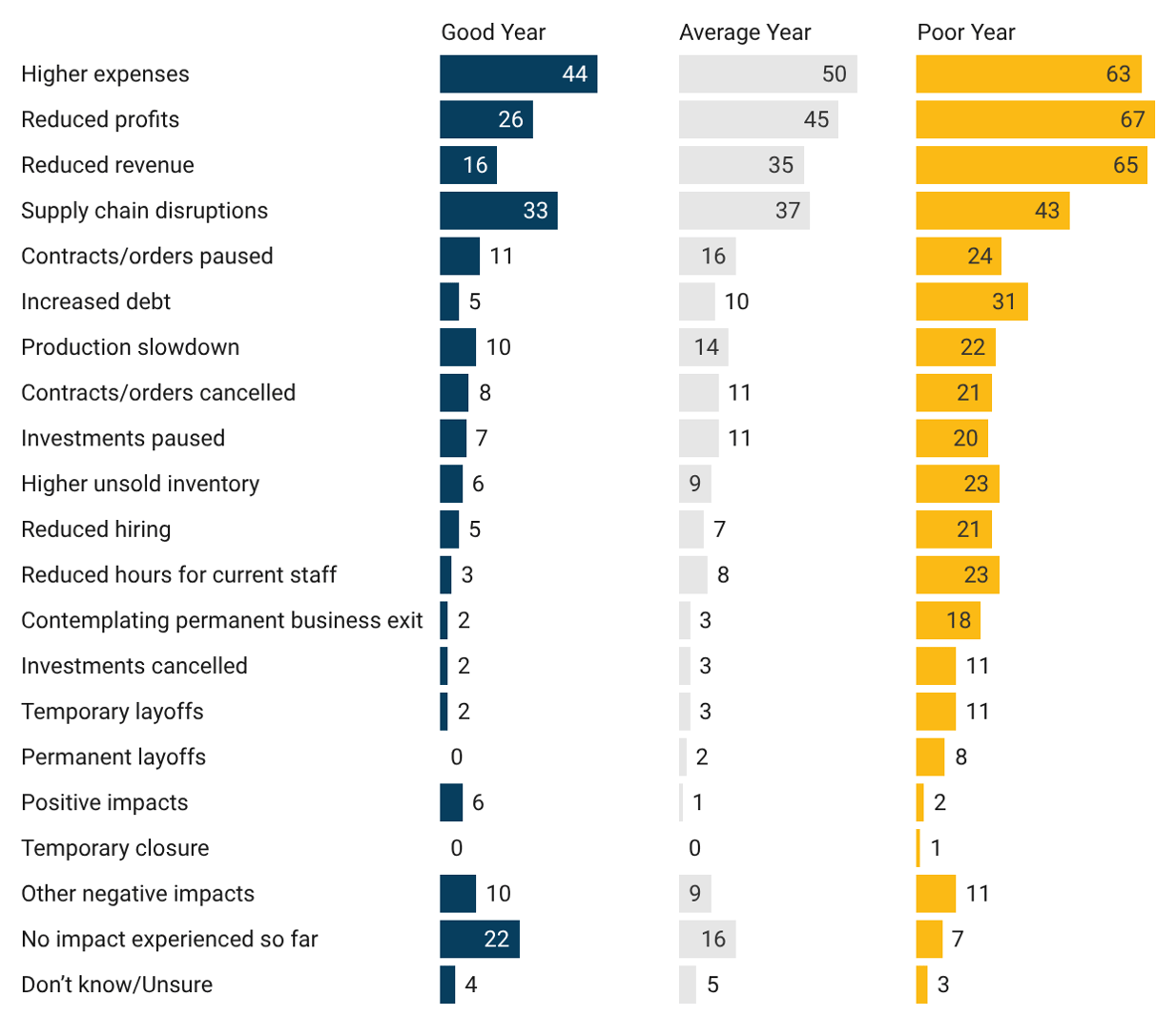
Question: What impact, if any, has your business experienced so far due to the U.S.-Canada trade war? (Select all that apply)
Source: CFIB, Your Voice – December 2025 survey, December 4 - 31, 2025, n=1,633.
Businesses that reported an “average” or “good” year were not immune to the impacts of tariffs, with many facing higher expenses, reduced profits, and supply chain disruptions. However, these effects were more contained than those reported by businesses experiencing a “poor” year.
While these types of impacts can threaten long‑term viability for all businesses, they are especially severe and destabilizing for those less able to mitigate them. For instance, only 2% reporting an average or good year contemplated permanently closing their business because of tariffs compared to 18% of poor-performing businesses.
While the survey data show clear differences in the depth of impacts, it is not possible to determine why some businesses were better able to manage tariff pressures. Several factors could be at play. For instance, better performing firms may have had stronger financial buffers, been able to adjust pricing more quickly, or diversified suppliers or markets in ways that reduced their exposure.
Why tariff pressures matter for Canada’s entrepreneurial future
Firm‑level tariff pressures matter not only for business performance in 2025 but also for Canada’s broader entrepreneurial climate. When businesses reduce investment, delay expansion plans, or take on additional debt, it can affect the pipeline of firms that would otherwise launch, scale up, or choose to grow — deepening the entrepreneurial drought already visible in national data.
What small businesses need from government
Given the widespread impacts businesses are experiencing from the U.S.–Canada trade war, we asked which federal measures would help them manage these pressures. Top actions cited by small business owners were to work with the U.S. to reduce trade uncertainty, lower internal trade barriers, and offer broad‑based tax relief (Figure 4). These selections show that businesses are looking for predictable trading conditions and cost relief to help offset the pressures of the ongoing trade war.
Figure 4: Top actions the federal government should take to mitigate tariff impacts on businesses
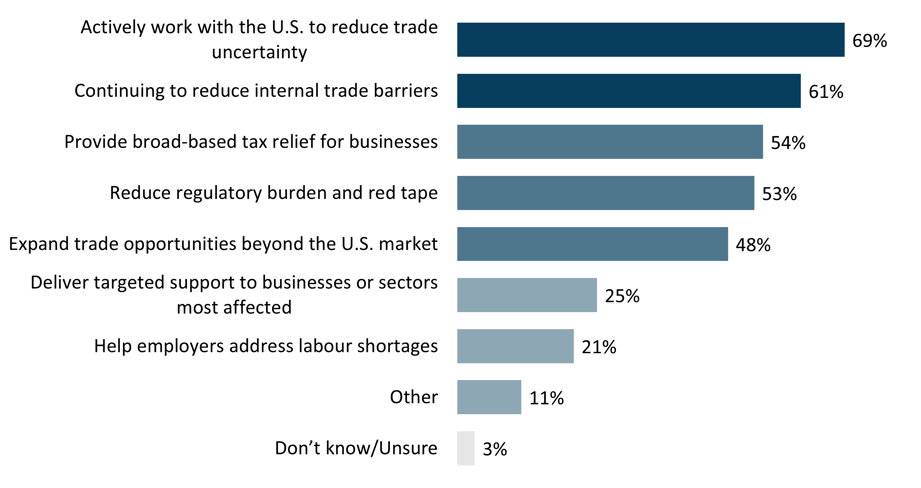
Question: What is the best way the federal government could help your business manage the impact of tariffs? (Select all that apply)
Source: CFIB, Your Voice – December 2025 survey, December 4 - 31, 2025, n=1,322.
Support for broad-based tax relief over targeted support
Survey results show that small businesses prefer broad‑based tax relief over targeted programs (Figure 4). This reflects a desire for support that is simple, flexible, and easy to access. Targeted programs, while helpful in principle, often come with eligibility requirements and application processes that add to small businesses’ already substantial administrative burden. A second related limitation is low awareness, which further limits uptake of available programs. Lastly, targeted programs can inadvertently pick winners and losers, leaving many SMEs without access to support. Ultimately, the characteristics of such programs can stifle competition, hamper innovation, and pose challenges for small business growth.
Examples of targeted support
RTRI
The federal government’s Regional Tariff Response Initiative (RTRI) illustrates these challenges. Designed to support businesses impacted by the ongoing trade disruptions by funding productivity, growth, and market-diversification projects, the program has seen minimal uptake: over three quarters of small businesses remain unaware of the RTRI (Figure 5), and fewer than 1% have applied.
Figure 5: Awareness of the Regional Tariff Response Initiative
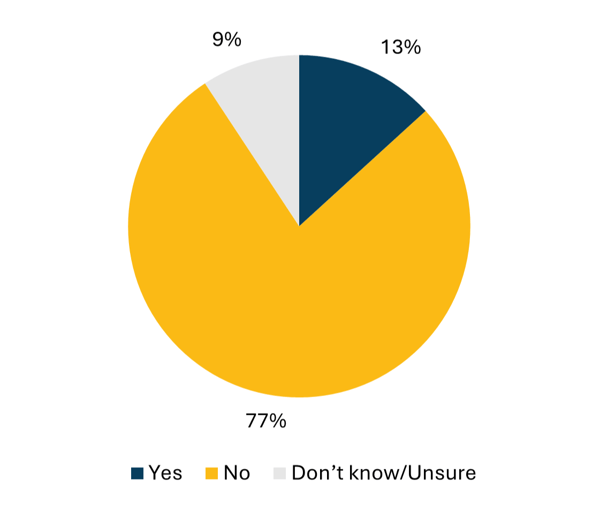
Question: Prior to this survey, were you aware of the Regional Tariff Response Initiative (RTRI)? (Select one)
Source: CFIB, Your Voice – December 2025 survey, December 4 - 31, 2025, n=1,617.
Businesses have also noted the RTRI’s strict eligibility requirements and complex application processes as deterrents for applying. The eligibility criteria vary, often excluding small businesses that are affected by the ongoing U.S.-Canada trade war — particularly those that are very small, newly formed, or below minimum revenue thresholds.
Corporate subsidies to large businesses
Corporate subsidies such as the recent series of large subsidies aimed at supporting the domestic EV battery industry often contribute to an unfair playing field between by artificially lowering the costs for big businesses, granting them a competitive advantage over their smaller counterparts. Moreover, there is a risk that subsidized large corporations can leverage their financial superiority to erect barriers to entry for smaller competitors.
Benefits of broad-based tax relief
By contrast, offering broad-based tax relief, such as reducing the small business tax rate (top tax area businesses want cut), would give more businesses greater financial flexibility during a time of economic uncertainty. This allows businesses to allocate tax savings where it matters most, whether paying down debt, increasing employee compensation, or expansion.
Conclusion and Recommendations
Tariff-related pressures have intensified an already difficult year for many small businesses, particularly those reporting weaker performance. These challenges come at a time when Canada’s entrepreneurial momentum is slowing, making it even more important to reduce avoidable pressures.
The following recommendations outline how the federal government can best support small businesses during the ongoing trade war:
- Provide broad tax relief measures, such as a reduction in the small business tax rate and/or the Employment Insurance (EI) premiums for small businesses.
- Prioritize CUSMA negotiations to restore stability, reduce trade uncertainty, and protect the cross‑border supply chains small businesses rely on.
- Ensure counter‑tariff revenues are redistributed to affected small businesses through a straightforward and accessible reimbursement process.
- Remove interprovincial trade barriers, so Canadian businesses can more easily diversify their operations across Canada.
- Reduce regulatory burden by implementing a “2 for 1” rule where 2 rules are eliminated for every new one introduced and making regulatory modernization a priority.