




As a possible hydroelectricity agreement with Quebec raises the prospect of new provincial revenue, fresh CFIB survey results show that Newfoundland and Labrador's small business owners want that money to ease the structural costs weighing on them, while still chipping away at the province's debt.
Summary
- Cost relief dominates the wish list: Eliminating the 15% retail sales tax on insurance (62%), cutting the small business tax rate (52%), and reducing electricity costs (47%) are among owners’ most-selected uses for potential hydro revenue, cost-relief measures occupy four of the six most-chosen options.
- Owners also back fiscal discipline: More than four in ten (43%) want the revenue used to pay down the province’s debt, well ahead of longer-horizon options such as the Future Fund (14%).
- The pressures are structural: Insurance costs and tax and regulatory costs tie as the top input cost pressures for the province’s small businesses (each 69%), with electricity cited by 55%.
- The budget has started the job: The 2026-27 provincial budget cuts the small business tax rate on a phased path to 1% by 2028, acting on one of owners’ top asks, even as the province still runs a deficit and carries net debt near $20.8 billion. A windfall offers a chance to extend targeted relief without derailing debt reduction.
Small businesses in Newfoundland and Labrador are operating in one of the country’s most demanding cost environments. Owners describe being squeezed from both sides: input costs keep climbing, while soft demand and a shortage of skilled workers make it hard to grow the revenue needed to absorb them. The result is tight margins and little room to manoeuvre.
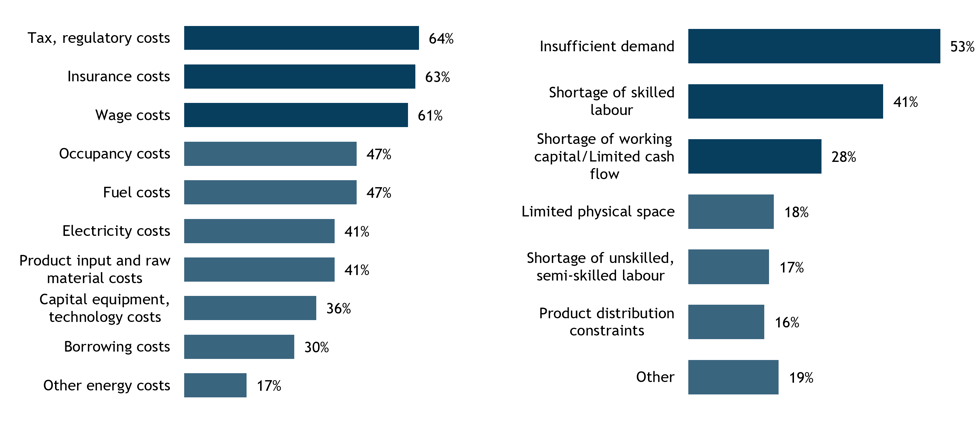
These pressures are structural rather than passing. According to CFIB’s Monthly Business Barometer® , insurance costs and tax and regulatory costs tie as the top input cost pressures in the province, each cited by more than two-thirds (69%) of business owners. Wage costs follow at 62%, and energy compounds the burden, electricity and fuel costs are each cited by 55% of businesses. On the growth side, insufficient demand constrains 40% of owners and skilled labour shortages affect 39% (Figure 1).
Figure 1: Structural cost pressures dominate the outlook for Newfoundland and Labrador small businesses
Source: CFIB, Your business outlook survey, August 2025 - July 2026, n=71.
Question: (Left) What types of input costs are currently causing difficulties for your business? (select as many as apply); (Right) What factors are limiting your ability to increase sales or production? (select as many as apply)
Note: Results are calculated as 12-month moving averages.
Against this backdrop, a possible agreement with Quebec on hydroelectricity generation has raised the prospect of new revenue for the province. That prospect prompts a practical question: if the money materializes, where should it go? CFIB asked Newfoundland and Labrador business owners directly, and their answers are revealing.
Where Owners Want the Money to Go
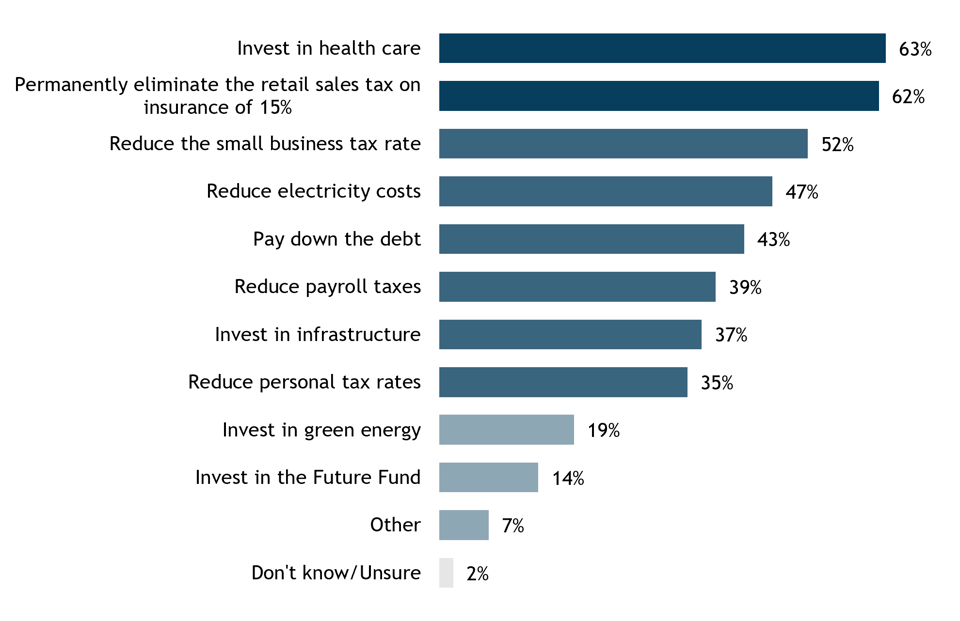
When CFIB asked members what the Provincial Government should do with revenue from a possible hydroelectricity agreement, owners spread their priorities across three broad goals: relief from costs, investment in services, and shoring up the province’s finances. Investing in health care topped the list at roughly two-thirds (63%), closely followed by permanently eliminating the 15% retail sales tax on insurance (62%) (Figure 2).
Cost relief stands out as the dominant theme. Four of the six most-selected options would directly reduce costs for businesses, including eliminating the insurance tax (62%), reducing the small business tax rate (52%), lowering electricity costs (47%), and reducing payroll taxes (39%). The measures owners prioritize align closely with the pressures identified in the figures above: insurance, taxes, and electricity.
Figure 2: New hydro revenue - Newfoundland and Labrador small business owners favour cost relief, but also back paying down the debt
Source: CFIB, Special field survey, October 22, 2025 - May 28, 2026, final results, n = 305
Question: What should the Newfoundland and Labrador government do with the revenue from a possible agreement with Quebec on hydroelectricity generation? (Select all that apply)
Crucially, that appetite for relief does not crowd out fiscal prudence. Paying down the province’s debt drew more than four in ten responses (43%), ranking ahead of infrastructure investment (37%) and personal tax cuts (35%), and well ahead of longer-horizon options such as investing in the Future Fund (14%). In other words, owners are not asking government to simply spend the money. They want relief and responsibility at the same time.
Health Care as an Economic Priority
The prominence of health care as the top priority for potential hydro revenues highlights that for small business owners, health care is not separate from the economy, it shapes it. This finding speaks to how directly the health care system shapes owners’ ability to operate, grow, and keep their teams working.
Long wait times, limited access to primary care, and unresolved health concerns land on Main Street as staffing gaps, lost productivity, and added strain on the employees left to cover. In a province already short on workers, a strained health system makes it harder for businesses to recruit and retain the people they need to stay open.
The impact is especially acute for small firms. Unlike larger employers, they often have limited capacity to absorb prolonged absences or redistribute workloads when employees are unable to access timely care. That is why owners ranked health care ahead of tax relief: a competitive tax environment means little if the workforce behind it isn't healthy enough to show up and work.
The message tracks with the rest of this survey. Investing hydro revenue in health care is investing in the economy for Newfoundland and Labrador’s small businesses, the two are one and the same.
Relief Within a Tight Fiscal Frame
Owners’ instinct to protect the province’s finances is well founded, and the 2026-27 budget shows why. The province is projecting a deficit of $688.5 million in 2026-27, with net debt reaching $20.8 billion by the end of the year, equivalent to about 43.5% of GDP. Annual deficits are also projected to continue into 2030-31.1 There is, in short, no room for indiscriminate spending, which is precisely why debt reduction ranks as a priority for business owners.
Staying on that path depends on the province meeting the numbers it sets. A recent CFIB report on budget accuracy in Atlantic Canada found that Newfoundland and Labrador tracks its spending closely, expenditures came in an average of about 1.4% above budget across the 2021-2025 public accounts, and the province’s largest single deviation (5.1%) came from underspending.2 The weaker link is revenue. Because oil and gas make up a volatile share of provincial income, revenue forecasts can be difficult to predict. Oil royalties fell from 32% of revenues in 2012 to about 15% in recent years. Adding to the challenge, the province has received less in federal transfers than it budgeted in 12 of its past 15 budgets. Put simply, the province is disciplined on what it spends but repeatedly misses on what it expects to collect.
That record matters for how hydro revenues should be treated, because such revenue would be exactly the kind of uncertain, volatile income the province has struggled to forecast. The same CFIB report urges provinces to meet their forecasts, direct unexpected revenue toward paying down debt, and commit to a measurable path to fiscal stability, guidance that favours building relief on steady, affordable footing rather than on money that may or may not arrive.2 That recommendation is consistent with CFIB’s broader research across Atlantic Canada, which finds overwhelming support among small businesses for balancing budgets and paying down debt.3
Even so, the budget shows that targeted relief can be delivered within a tight frame. It reduces the small business tax rate on a phased schedule—to 2% as of January 1, 2026, 1.5% in 2027, and 1% in 2028, a measure the province expects will benefit over 6,000 small businesses.1 That measure answers one of owners’ clearest asks directly: over half (52%) named a lower small business tax rate as a priority. Crucially, it is a structural, scheduled cut that does not hinge on a windfall, the kind of measured relief that holds up even when revenue forecasts do not.
The province’s own recovery plan brought forward back in 2021, The Big Reset, made the same point about windfalls, warning that past oil revenues were spent rather than saved, when they could have paid down debt or seeded a Future Fund.4 Taken together, the lesson points in two directions at once: use part of any windfall to keep bringing the deficit down while meeting forecasts, and use part to fund the next round of targeted relief, eliminating the insurance tax, easing electricity costs, and lowering payroll taxes - building on the approach the budget has already begun.
Conclusion and Recommendations
Newfoundland and Labrador's small business owners are sending a clear, consistent message. Cost pressures rank among their top concerns and rising costs are making it harder to hire, invest, and keep doors open. When it comes to possible hydro revenues, they want government to use it to lower the cost of doing business first. At the same time, they want a large share directed to paying down the province's debt rather than spent in full. That's not a contradiction - it's balance. Small business owners understand that short-term relief and long-term fiscal health go hand in hand. A windfall spent entirely on new programs offers little protection if debt continues to grow and future budgets tighten again.
The 2026-27 budget already struck this balance. It paired a phased small business tax cut with continued deficit reduction, delivering relief without abandoning fiscal discipline. Small business owners are asking government to keep doing both: use new revenue to strengthen the private sector and keep the province's finances on a sustainable path.
To turn potential revenue into lasting relief, CFIB recommends that the Provincial Government:
- Follow through on the small business tax cut: Stay the course on the phased reduction to 1% by 2028, delivering on relief that over half (52%) of owners identified as a priority.
- Eliminate the 15% retail sales tax on insurance: The top remaining cost-relief ask (62%), it speaks directly to insurance costs, which tie as the province’s highest input cost pressure (69%).
- Provide electricity cost relief: Nearly half of owners (47%) want lower electricity costs, and 55% cite electricity as a cost pressure, one of the province’s most distinctive burdens.
- Also focus on debt reduction: With the province still running a deficit ($688.5 million in 2026-27) and net debt near $20.8 billion, dedicate a share of any hydroelectricity revenue to paying down the debt —a discipline 43% of owners themselves endorse.