



Summary
- About one in seven small businesses (15%) report supply and price disruptions for non-fuel goods transiting the Strait of Hormuz, including fertilizer, steel, and other inputs.
- The greatest impacts are concentrated in agriculture (44%) and manufacturing (20%) sectors.
We recently examined how fuel prices are adding pressure on Canada's small businesses. But for many owners, the squeeze goes well beyond the pump, with shipping disruptions linked to the Strait of Hormuz also impacting the availability and price of non‑fuel input costs. Sharp year-over-year price increases are currently recorded on world markets for key raw materials and business inputs.
Figure 1: Year-over-year price change for select commodities, early May 2026
-1.png?width=966&height=677&name=image%20(20)-1.png)
Source: CFIB and Trading Economics
The ripple effects of these disruptions have already reached the Canadian economy to a large extent, as highlighted by new results from CFIB’s April 2026 Your Voice Survey showing that 1 in 7 (15%) of small businesses now count Hormuz non-fuel disruptions among their top challenges.
Figure 2: Businesses' biggest challenges, April 2026
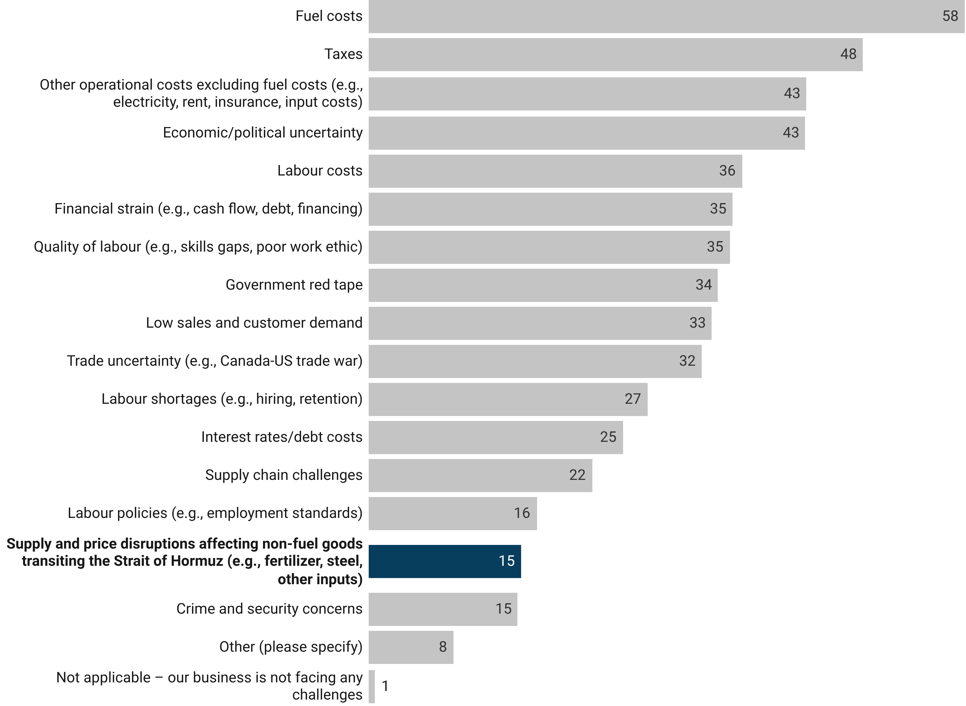
Source: CFIB, Your Voice survey, April 9-27, 2026, n= 1,611.
Question: What are the biggest challenges your business is facing right now? (Select all that apply) [Share of respondents (%)].
While this share may seem modest at first glance, it understates how disruptive these issues can be for businesses that rely on time‑sensitive or imported inputs, adding further strain to already tight margins and an uncertain operating environment.
A global shipping risk with local consequences
The Strait of Hormuz is one of the world’s most important shipping corridors. Heightened geopolitical risks in the region have translated into shipping limitations and delays, higher insurance costs, and increased freight rates. For Canadian small businesses, these global disruptions show up locally as higher prices and reduced availability of key non‑fuel inputs, including fertilizer, aluminum, construction materials, and manufactured components.
These dynamics add to the pain of the high-cost environment businesses have been dealing with in recent years. CFIB’s April Monthly Business Barometer® results show 40% of businesses experienced difficulties with product input and raw material costs that month, a share that remains well above the historical average of 29%.
Hormuz‑related supply disruptions add complexity and uncertainty to an already difficult operating environment. For some businesses, higher input costs or delays quickly translate into tough trade‑offs, especially in sectors where timing and materials are critical.
Agriculture and manufacturing, Prairie firms face disproportionate impacts
On their own, the 15% of businesses naming this among their biggest challenges may seem modest compared with fuel costs (60%) and taxes (48%). But the aggregate figure masks how disruptive these issues can be for certain sectors with some industries far more exposed than others.
Figure 3: Share of businesses reporting Strait of Hormuz—related disruptions, by sector
-1.png?width=2400&height=1383&name=image%20(19)-1.png)
Source: CFIB, Your Voice survey, April 9-27, 2026, n= 1,611.
Question: What are the biggest challenges your business is facing right now? (Select all that apply) [Share of respondents (%)].
Note: *Small sample size (<20).
Agriculture stands out as the most affected sector by a wide margin. Over four in ten (44%) of these businesses identify supply and price disruptions affecting non‑fuel goods as a top challenge. Reliance on imported, price‑sensitive inputs like fertilizer leaves farm businesses particularly exposed when shipping disruptions occur, especially during time‑sensitive periods such as planting season.
“As a farmer, the dramatic rise in diesel fuel and fertilizer prices—combined with flat commodity prices—is very concerning.”
– Ontario business owner
Manufacturing businesses are also more affected than average (20%), reflecting their reliance on imported raw materials, components, and intermediate goods. Higher input costs and delivery uncertainty complicate production planning, adding to pressure in an already uneven demand environment.
For businesses such as farms and manufacturers, delays or price spikes for critical inputs can have outsized effects on both production costs and availability. When supplies are delayed or costs rise, these pressures are often difficult to absorb or pass on, meaning the impact can be significant even though exposure is limited to a narrower set of businesses.
Geographically, Prairie businesses are more affected than average (18%-22%), which reflects the importance of commodities-exposed sectors like farming to the economy of that part of the country.
Figure 4: Share of businesses reporting Strait of Hormuz–related disruptions, by region
-1.png?width=980&height=346&name=image%20(21)-1.png)
Source: CFIB, Your Voice survey, April 9-27, 2026, n= 1,611.
Question: What are the biggest challenges your business is facing right now? (Select all that apply)
Fuel and non-fuel disruptions: a compounding effect
The impact of the Strait of Hormuz-induced disruptions is also compounding for the businesses directly impacted by them. Businesses impacted by non-fuel disruptions are much more likely to also be impacted by fuel costs (86%) than businesses not impacted by non-fuel disruptions (53% impacted by fuel costs).
The bottom line
While fuel prices command the most attention, global shipping disruptions are quietly adding to cost pressures for small businesses. At a time when businesses are already stretched thin, reducing domestic cost burdens like taxes and red tape can help businesses better absorb shocks beyond their control.