




Summary
- Canada’s labour shortage reflects a multi-dimensional mismatch between youth and available jobs, shaped by geographic differences, job preferences and structural constraints that limit participation.
- Geographic divides shape labour mismatches: although urban areas also face hiring challenges, rural communities are more constrained by smaller labour pools, fewer youth, and harder‑to‑fill roles.
- The Temporary Foreign Worker Program remains essential in helping small businesses fill persistent gaps in roles that local youth are unwilling or unable to take, in addition to helping protect Canadian jobs in local businesses.
Canada’s labour market is sending mixed signals: youth unemployment is high, but some small businesses are still struggling to hire. At first glance, these trends seem contradictory: if more young people are looking for work, why do so many small firms continue to report labour shortages? The answer: not all jobs can be filled by youth.
Often, available jobs in small businesses do not align with youth due to factors such as location, sector, schedule, working conditions, or expectations. Building on CFIB’s Work in Progress: Bridging the Gap Between Small Businesses and Youth, this analysis examines how youth willingness to relocate or take certain jobs contribute to persistent labour mismatches, helping explain why programs like the Temporary Foreign Worker Program (TFWP) remain necessary to address persistent labour shortages.
Understanding the labour market mismatch
Canada’s labour shortage is not driven by a single issue, but by a combination of mismatches between youth and available jobs. These gaps are primarily geographic, preference-based, and structural. Together, they help explain why many small businesses continue to struggle to hire despite higher youth unemployment.
Geographic mismatch: Where youth live vs. where jobs are
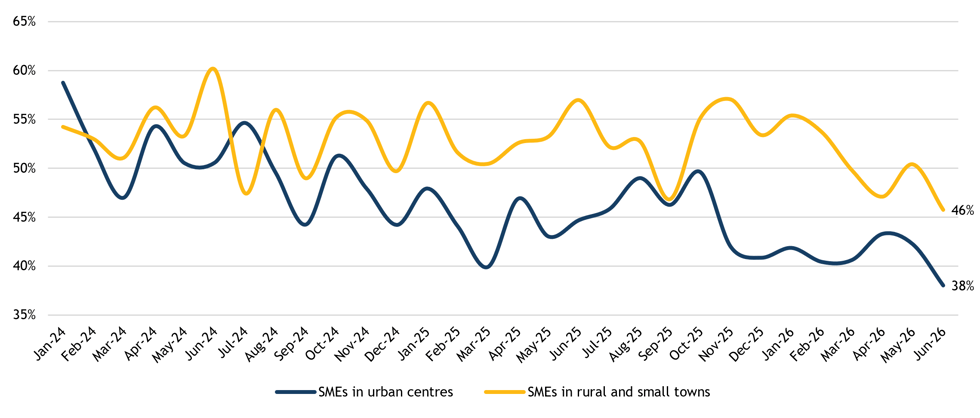
One of the clearest factors behind the current labour market mismatch is rooted in geography. Youth—defined by statistics Canada as those aged 15 to 24—make up a larger share of the urban population (12.3%) than of the rural and small-town population (10.6%).[i] Meanwhile, CFIB’s Monthly Business Barometer shows that, on average, small businesses operating in rural areas and small population centres report higher labour shortages compared to urban centres (Figure 1). In June, nearly half of rural and small-town businesses (46%) reported labour shortages compared to less than two in five urban businesses (38%).
Based on CFIB’s Your Voice September 2024 survey results, recruitment challenges were also more prominent outside cities, with more than one in two (54%) rural small businesses reporting difficulty attracting skilled workers versus 40% in urban areas, highlighting persistent barriers to filling certain roles.[ii] Even with this gap, it is clear that urban centres still face labour challenges in finding suitable candidates, in particular, small businesses that require non-standard roles with irregular hours or specialized requirements.
Figure 1: A higher share of SMEs in rural areas consistently report labour shortage as a constraint compared to urban centres
Source: CFIB, Business Barometer – January 2024- June 2026, more details available at cfib.ca/barometer.
Question: “What factors are limiting your ability to increase sales or production?” The share above represents the respondents who selected [Shortage of skilled labour] and/or [Shortage of unskilled, semi-skilled labour]. (Urban centres have a population of 30,000 or more)
Preference mismatch: What jobs youth are willing to take
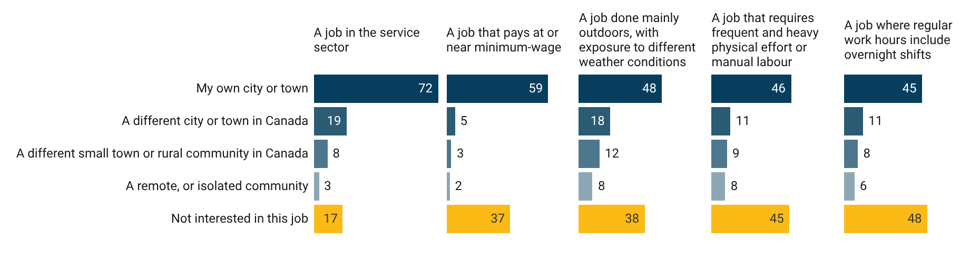
Beyond geographic factors, many available jobs do not align with youth preferences. In particular, youth show limited willingness to take roles with certain conditions and are often unwilling to relocate for them. Even when they live in areas with vacancies, a significant share are not willing or able to take those jobs. As seen in Figure 2, nearly half of youth would be unwilling to look for jobs that require regular overnight shifts or jobs that require frequent and heavy physical effort. More than a third would be unwilling to look for jobs that are mainly outdoors and exposed to weather conditions, or jobs that pay at or near minimum wage.[iii]
Figure 2: Youth willingness to relocate for specific types of jobs
Question: In which locations would you be willing to look for the following jobs?
Source: Angus Reid, Youth Public Opinion Poll, March 10-13, 2026, n = 283-290.
Note: Respondents who selected “Don’t know/Unsure” were excluded from the analysis.
Even when youth are open to certain roles, that willingness often depends on staying local. For example, while only 17% of youth say they are not interested in looking for service-sector jobs, 72% are willing to look for service jobs within their own city or town. Far fewer are willing to move for those same opportunities: only 19% would consider relocating to a different city or town in Canada, and just 8% would consider moving to a small town or rural community. Interest in relocating to remote and isolated communities is even lower, at 3%. These findings align with similar research done in the U.S. and Australia, as young people are more likely to move to large urban centres for work, not from them.
Similarly, more than half of youth would be willing to look for a minimum-wage job, which ranges from $15-$19 depending on the province, within their own town or city. However, only 5% would be willing to look for those jobs in another Canadian town or city and only 3% would be willing to do so in a small town or rural community. This pattern is consistent across job types suggesting that, while some young people may be willing to consider minimum wage, physically demanding, outdoor, or irregular-hour jobs locally, very few are willing to relocate for such positions.
Structural constraints: barriers limiting youth participation
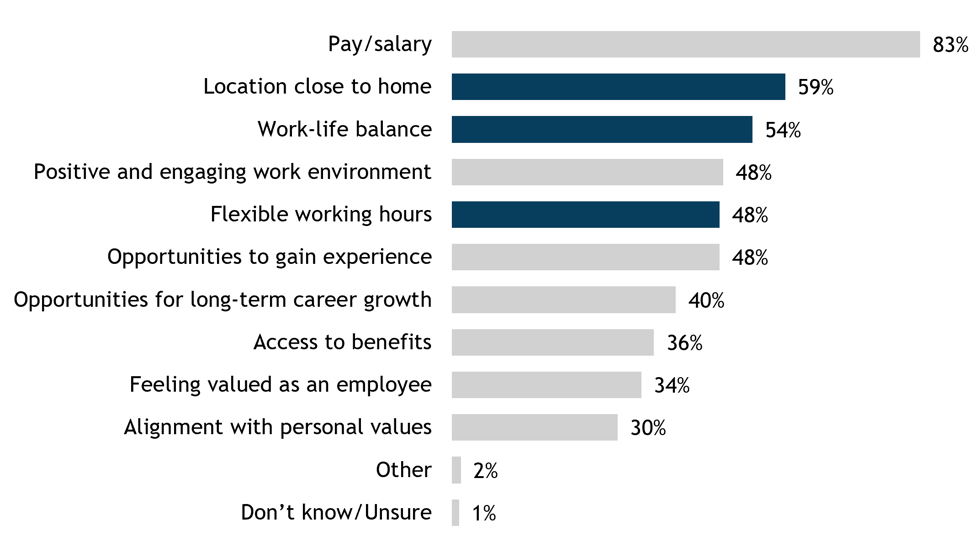
There are also constraints inherent to being a youth that restrict them from participating in certain jobs, especially in certain regions. More than half of youth (59%) cite location close to home as a top priority when looking for jobs (Figure 3). Young job seekers may lack access to a driver’s licence or a car, or live in areas with limited public transit, which can geographically restrict the jobs they are willing or able to apply for. In addition, those under the age of majority may be ineligible to work in age-regulated sectors such as bars, wineries, or breweries.
Figure 3: Top priorities for youth seeking employment
Question: Which of the following do you consider most important when looking for a job? (Select all that apply)
Source: Angus Reid, Youth Public Opinion Poll, March 10-13, 2026, n = 308.
Alongside location close to home, many cite work-life balance (54%) and flexible hours (48%) as top priorities. For youth still in school, relocation is not realistic and jobs with irregular hours are not practical. This explains why available jobs that appear potentially accessible for youth remain difficult to fill for small businesses. For example, most students could not consider a position as an overnight dishwasher at a restaurant open 24/7 or a bakery that starts baking at 4am.
The TFWP remains essential for small businesses amid youth unemployment challenges
Labour market misalignment drives reliance on the TFWP
High youth unemployment does not guarantee a readily available local workforce for every type of job, particularly in rural areas or for seasonal, physically demanding, or non-standard hour roles. The mismatches outlined above help explain the persistent labour shortages reported by small businesses, even as many youth struggle to find work.
Nearly four in five small businesses (78%) say the TFWP provides access to skilled and reliable workers they cannot find locally, and 90% report difficulty filling positions previously held by TFWs with local employees.[iv] In practice, employers rely on Temporary Foreign Workers (TFWs) to fill specific roles for which suitable local candidates are not available as a last resort. All to say, this program helps fill jobs that would otherwise go unfilled, rather than taking jobs from Canadian youth.
By helping businesses stay open, the program supports small business growth and stability, which can create new opportunities for Canadian youth hiring and help retain the young workers they already employ.
TFWs fill critical gaps in essential, hard-to-staff roles
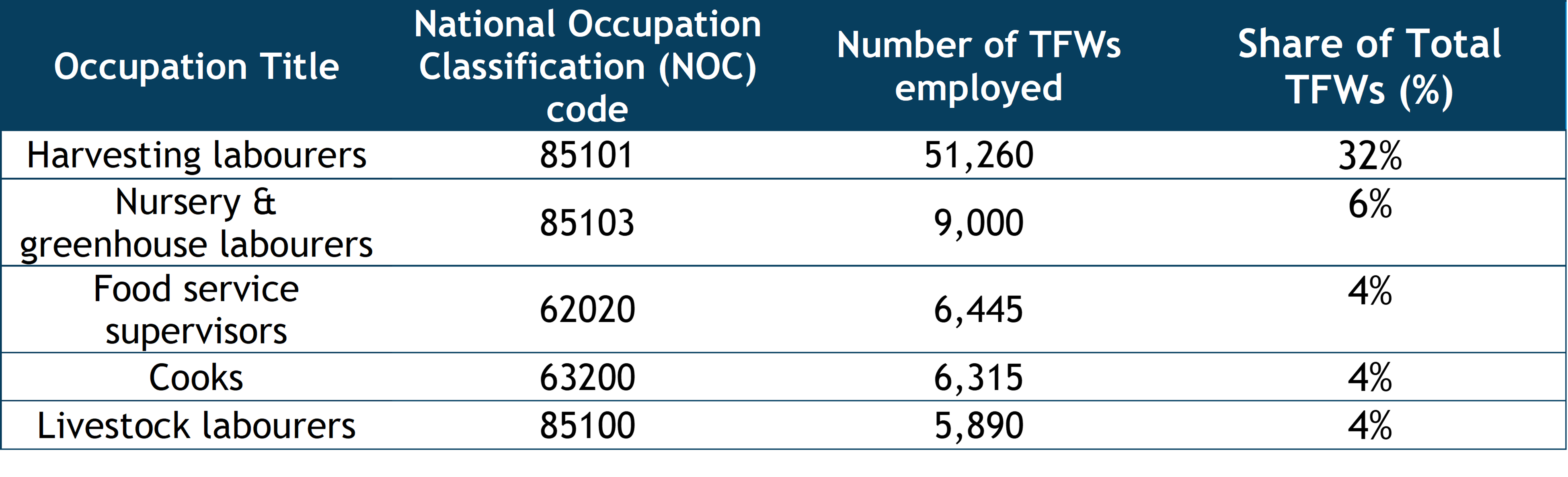
The latest data shows nearly a third of all temporary foreign workers in Canada were harvesting labourers in 2025—a job that requires frequent heavy physical labour and is exposed to the elements (Table 1). Other occupations that hired a significant amount of temporary foreign workers include nursery and greenhouse labourers (6%), food service supervisors (4%), and cooks (4%), many of which involve irregular hours, seasonal work, or rural locations. These are precisely the types of jobs youth are least willing to take.
Table 1: Top five occupations by number of temporary foreign Workers
Source: “How many permits were issued broken down by province, region, and occupation?” Immigration, Refugees and Citizenship Canada, November 2025, Accessed
June 12, 2026. https://www.ourcommons.ca/written-questions/45-1/q-798?response=13978367§ion=ircc
For many firms, TFWs are not optional. They are what keep their business running. More than half of small businesses (52%) say that the TFWP has helped them stay open and continue employing Canadian workers, rising to 76% for hospitality businesses. Given that hospitality is often a key entry point for youth employment, the TFWP plays an important role in enabling small businesses to support and sustain jobs for their Canadian staff.
This dynamic is especially evident in sectors like food services, where maintaining core staffing levels enables businesses to hire and retain more youth overall. A restaurant, for example, may be able to hire youth for front-of-house roles, but without a late-night chef—a role that is often harder to fill—it cannot operate. In these cases, hiring a temporary foreign worker can be the difference between a business staying open or closing, as recent cases in the industry have shown.
Recent changes to the Temporary Foreign Worker Program are making it more difficult for small businesses to access the workers they need. Restricting access to the TFWP does not mean these jobs will be filled by jobless youth, it means the jobs will likely go unfilled altogether. For small businesses, that can mean scaling back operations, reducing services, or shutting down entirely which ultimately puts other Canadian jobs at risk. A responsive and accessible TFWP remains essential to small businesses and the communities they support.
What can the government do?
Maintaining access to the TFWP supports both Canadian small businesses and youth employment. Government policies need to better connect youth to suitable opportunities and ensure businesses can still access workers through programs, like the TFWP, when local hiring isn’t enough.
Recommendations to support youth employment
- Lower the cost of hiring youth: Reduce payroll taxes or offer targeted incentives (e.g., EI premium holidays, refundable tax credits) to encourage small businesses to bring on young workers.
- Expand work-integrated learning: Increase access to co-ops, internships, and apprenticeships, and extend supports to small businesses.
- Simplify hiring supports: Cut red tape and streamline existing youth hiring programs so SMEs can actually use them.
- Improve job awareness: Provide clearer, more accessible labour market information so youth can easily identify what roles are in-demand, and where vacancies exist.
Recommendations to improve access for small businesses to the Temporary Foreign Worker Program
- Protect and maintain the Temporary Foreign Worker Program (TFWP).
- Grandfather existing foreign workers by allowing employers to extend work permits under previous rules (e.g., prior caps, no refusal-to-process, lower prevailing wage thresholds).
- Remove or significantly scale back refusal-to-process policies, prevailing wage increases, and TFWP caps that limit employer access.
- Prioritize and expand permanent residency pathways for temporary foreign workers already in Canada.
- Introduce a dedicated stream for foreign workers with at least 18 months of Canadian work experience at any TEER level, provided they have legal status and have paid taxes.
- Introduce a dedicated stream for foreign workers with at least 18 months of Canadian work experience at any TEER level, provided they have legal status and have paid taxes.
- Increase economic immigration allocations, particularly to provinces and rural and non-urban communities.
- Introduce occupation-based flexibility within the TFWP by creating a category for consistently hard-to-fill jobs (e.g., overnight, physically demanding, or high-turnover roles), with adjusted caps and wage rules to reflect persistent shortages regardless of location
- Maintain federal oversight of the TFWP to ensure consistent rules nationwide, recognizing its economy-wide impact rather than allowing provincial adoption to shape its implementation.