



Summary
- Higher fuel prices are reducing household spending power: Recent Leger polling found that 72% of Canadians report a negative impact on their personal finances from higher fuel prices. CFIB estimates fuel costs have increased by about $53 per vehicle per month. Across Canada, this translates to roughly $1.3 billion in additional fuel costs every month—money that is no longer available for other household purchases.
- SMEs are being squeezed from both sides: Higher fuel prices are increasing operating costs while also weakening consumer demand. At a time when insufficient demand is already the leading constraint on sales and production, many SMEs are facing pressure from both rising costs and softer customer spending.
- Fuel prices remain elevated: The Iran-U.S. conflict pushed gasoline prices to a three-year high. While prices have eased from their peak, they remain well above pre-crisis levels and will take time to adjust.
Introduction
The outbreak of conflict between Iran and the United States earlier this year pushed gasoline prices to a three-year high, adding pressure to household and business budgets across Canada.
Fuel prices are having a tangible impact on household finances across Canada. Recent Leger polling in June 2026 found that 72% of Canadians report that higher gas and diesel prices are negatively affecting their personal finances. More importantly, many Canadians are already changing their spending habits to cope with these higher costs. The survey found that 38% are going out less often, 25% are cutting spending in other areas to pay for fuel, and 22% are reducing their summer travel plans.
These changes matter for small businesses. When households devote a larger share of their budget to fuel, less money remains available for discretionary purchases such as dining out, retail shopping, tourism, recreation, and personal services. As a result, many SMEs may experience weaker demand for many of the goods and services they provide.
While much attention has focused on how geopolitical tensions in the Middle East have affected oil and fuel markets, the consequences are being felt on Main Street across Canada. For small businesses already grappling with elevated operating costs, higher fuel prices create a double squeeze: rising costs on one side and softer consumer demand on the other. This blog explores how that dynamic is affecting Canada’s small businesses.
SMEs are being squeezed from both sides: cost and demand
Small businesses continue to face elevated operating costs. Higher fuel costs increase transportation costs and raise the cost of petroleum-based products used throughout the economy, from fertilizers to plastics. Previous CFIB InsightBiz blog posts have examined the impact of fuel and non-fuel costs in more detail.
But elevated fuel costs affect more than business costs. They also put pressure on household finances. As households spend more on fuel, less income is available for other goods and services, reducing spending at many small businesses.
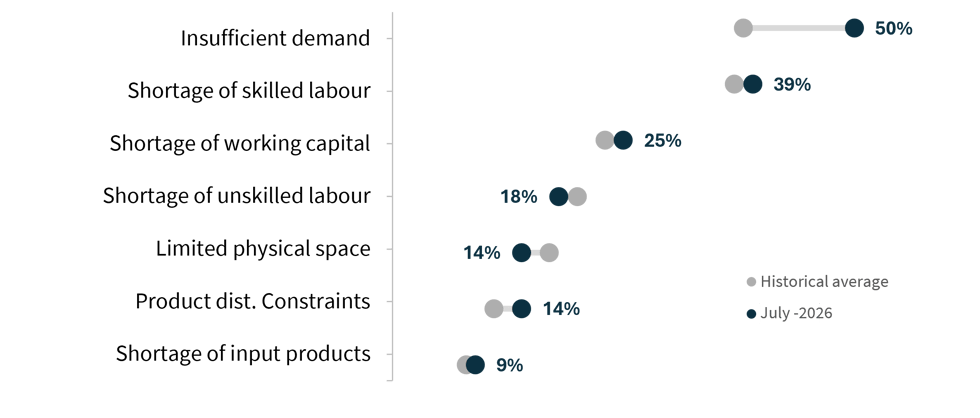
This is particularly concerning at a time when insufficient demand is already the primary challenge facing many small businesses. According to CFIB’s July 2026 Business Barometer® survey, insufficient demand has overtaken labour shortages, distribution and space limitations, and input shortages as the leading factor in limiting sales and production (Figure 1).
These cost and demand challenges come at a time when Canada is continuing to face an entrepreneurial drought, with business exits outpacing entries. Persistent cost pressures and soft demand risk weakening incentives to start, grow, and sustain a business.
Figure 1: Insufficient demand remains the primary factor limiting business owners’ ability to increase sales or production
Sources: CFIB, Your Business Outlook Survey, July 2026, n= 520.
Question: What factors are limiting your ability to increase sales or production?
Higher fuel prices are costing Canadians $53 more per vehicle per month —reducing household spending power by $1.3 billion nationwide
While recent polling suggests higher fuel prices are affecting household finances, the next question is how much these additional costs are reducing spending power.
To help answer that question, CFIB estimated the additional fuel costs facing Canadian households since fuel prices began rising earlier this year. Based on gasoline sales, vehicle registration data (passenger vehicles and light trucks), and average retail fuel prices, higher gasoline prices have added significantly to household transportation costs. [i] The complete description of the calculation can be found in the methodology section.
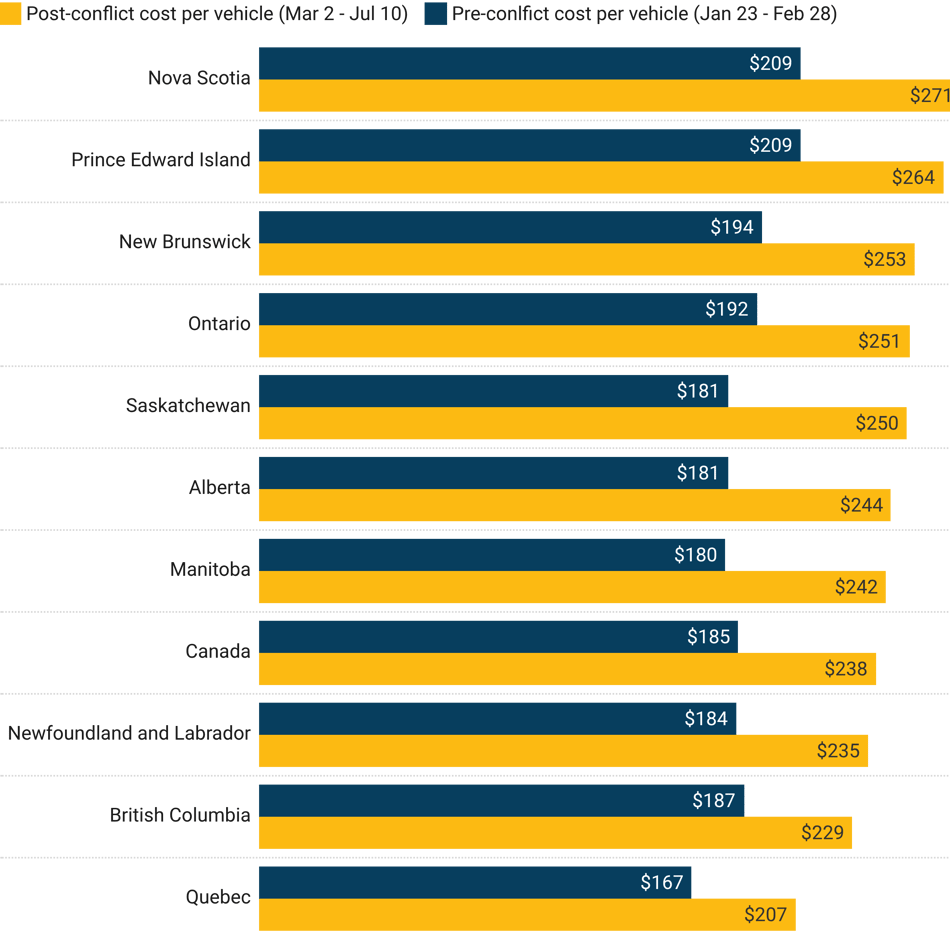
At pre-war prices of roughly $1.38 per litre, the monthly cost of fuel was about $185 per vehicle (Figure 2). During the period following the onset of the conflict, gasoline prices averaged approximately $1.78, increasing the cost of purchasing the same amount of fuel to roughly $238 per vehicle per month.
In other words, higher fuel prices increased monthly fuel expenses by about $53 per vehicle, or nearly 30%. Across Canada, this translates to roughly $1.3 billion in additional fuel costs each month, money that is no longer available for other household purchases. [ii] The impact is not being felt equally across the country, however. As shown in Figure 2, the increase in monthly fuel costs ranges from 23% to 39% across provinces, meaning some households are facing considerably greater budget pressures than the national average.
Figure 2: The monthly cost of fuel per vehicle has increased by 23%-39% across Canada, adding to household pressures
Sources: CFIB calculations, Statistics Canada, Sales of fuel used for road motor vehicles; Statistics Canada, Vehicle registrations, by type of vehicle and fuel type; Natural Resource Canada, Daily Average Retail Prices for Regular Gasoline in 2026.
Fuel prices remain elevated and will take time to adjust
While fuel costs eased from their Spring peak, they remain above pre-conflict levels. Canada’s monthly national average retail price of gasoline reached a three-year high in the Spring of 2026,[iii] rising by nearly 25% to pre-conflict levels, and prices remain approximately 23% higher than before the conflict (Figure 3).
Figure 3: Despite recent easing, gas prices remain elevated relative to pre-crisis levels
Daily average retail prices for regular gasoline, Canada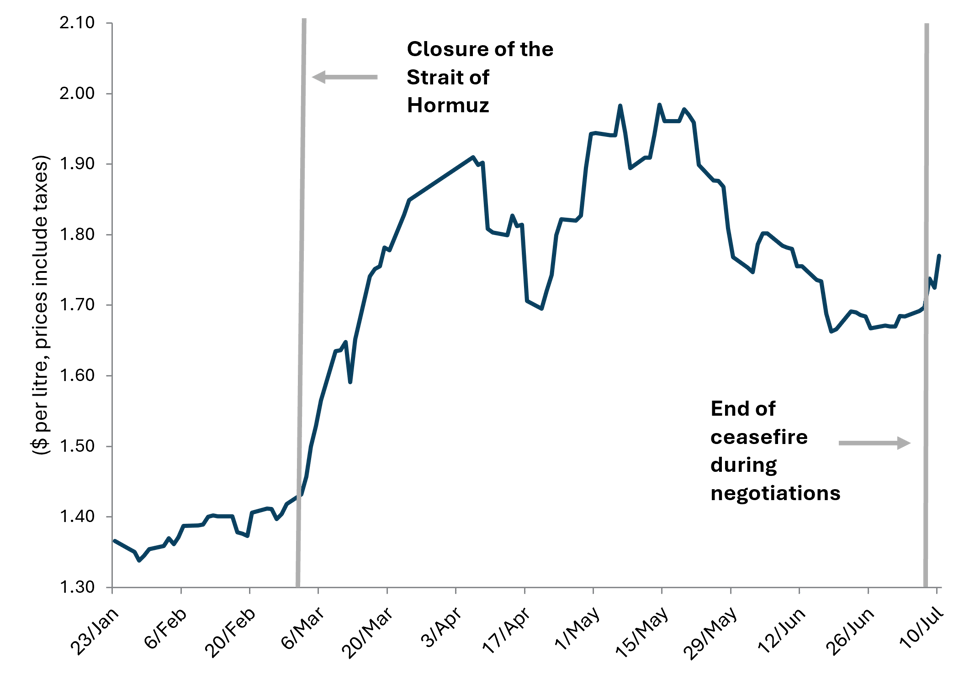
Sources: CFIB Calculations. Natural Resources Canada, Daily Average Retail Prices for Regular Gasoline in 2026
While U.S. and Iran negotiations continue, fuel markets remain vulnerable to uncertainty. Although pressures have eased from their peak, any relief at the pump is likely to be gradual. This reflects a broader pattern observed in past oil shocks, where prices tend to rise like a rocket but fall like a feather.[iv] As a result, even as market conditions improve, households and businesses may continue to face elevated fuel costs for some time.
The bottom line
While geopolitical tensions in the Middle East continue to weigh on global energy markets, Canadian SMEs face significant headwinds, as weak demand and high costs constrain business activity. Fuel prices are therefore more than an affordability issue; they are also a small business issue. Addressing these pressures requires policy measures that support household purchasing power and ease cost pressures for businesses, including:
- Reduce small business corporate income taxes:
Federal and provincial governments should lower the tax rate and increase the deduction threshold to provide relief.
- Eliminate the “tax-on-tax” permanently:
The federal government should permanently eliminate the “tax‑on‑tax” practice of applying GST to fuel excise taxes. - Provide excise tax relief during periods of elevated prices:
Federal and provincial governments should suspend or reduce excise taxes on fuel until prices return closer to pre‑crisis levels. - Strengthen Canada’s long-term energy affordability and security:
Federal and provincial governments should accelerate infrastructure projects, improve market access, and strengthen east‑west energy integration to help stabilize prices and enhance affordability for businesses nationwide.
Methodology
Household fuel costs:
The estimation of the average increase in household fuel costs was conducted in three main steps:
I. Estimating fuel consumption per vehicle
- Gasoline sales data (in litres) for 2024 were collected at the national, provincial, and territorial levels.
- To better reflect household usage, total gasoline sales were adjusted by applying a factor of 91%, corresponding to the share of fuel consumed by light-duty (passenger) vehicles.
- This adjusted total was then divided by the number of registered vehicles with a weight of up to 11,793 kg in the same year and geography.
- This provided an estimate of average annual fuel consumption per vehicle.
II. Estimating pre-and post-shock fuel prices
- Daily average retail gasoline prices for 2026 were obtained from Natural Resources Canada for major cities in each province, used as proxies for provincial prices.
- The pre-conflict period was defined as January 23 to February 27, 2026. The average price was calculated using all available daily observations over this period.
- The post-conflict period was defined as March 2 to July 10, 2026, following the onset of the Iran–U.S. conflict on February 28. The average price was similarly computed using daily data.
- Average monthly fuel consumption per vehicle was multiplied by the average price per litre for both periods.
- This yielded estimates of monthly fuel costs per vehicle before and after the shock, allowing for a comparison of the increase attributable to higher fuel prices.
- Assumption: The estimated increase in fuel costs assumes households purchase the same quantity of fuel before and after the increase in gasoline prices. Actual costs may be lower if households reduce driving or make other adjustments to fuel consumption in response to higher prices.