



Amid market shocks and rising operational costs, new survey results demonstrate how Canada's Business Risk Management (BRM) programs can better support small- and medium-sized agri-businesses.
Summary
- Most (53%) agri-businesses dislike the design of BRM programs, while only 33% say they are well-designed.
- Nearly three-quarters (72%) of agri-businesses say BRM applications are too time-consuming due to red tape.
- Agri-businesses describe widespread issues with payment delays, declining program value, and eligibility gaps.
Canada's agriculture sector is navigating one of the most difficult operating environments in recent memory. Trade pressures have reduced international sales opportunities and increased the price of key agricultural inputs, squeezing already slim profit margins. In turn, this uncertain economic environment has impacted business optimism, with the agriculture sector reporting the lowest average confidence level (40.1 points) on the July 2026 Business Barometer®.
BRM programs are intended to address periods of economic instability—with AgriStability covering major revenue shortfalls, AgriInvest bridging small income declines, the Advance Payments Program providing low-cost cash advances, and AgriInsurance offsetting losses from natural disasters or disease.
However, small and medium-sized enterprises (SMEs) describe significant gaps in this financial safety net. To understand their experiences with BRM programs, CFIB posed a series of questions in our 2026 Agriculture Survey.1 Several concerns stand out in the results. While most (53%) agri-businesses do not believe that BRM programs are well-designed, dissatisfaction extends beyond program structure (Figure 1). Nearly three-quarters (72%) say application processes are too time-consuming, making paperwork the most widely cited concern. Businesses are also less confident in program delivery, as they report mixed opinions about the timeliness and value of BRM payments. Together, these findings suggest that frustrations stem not only from program design, but also from administrative burden, unpredictable support, and overall value.
Figure 1: Agri-businesses identify paperwork, delays, and design flaws across BRM programs
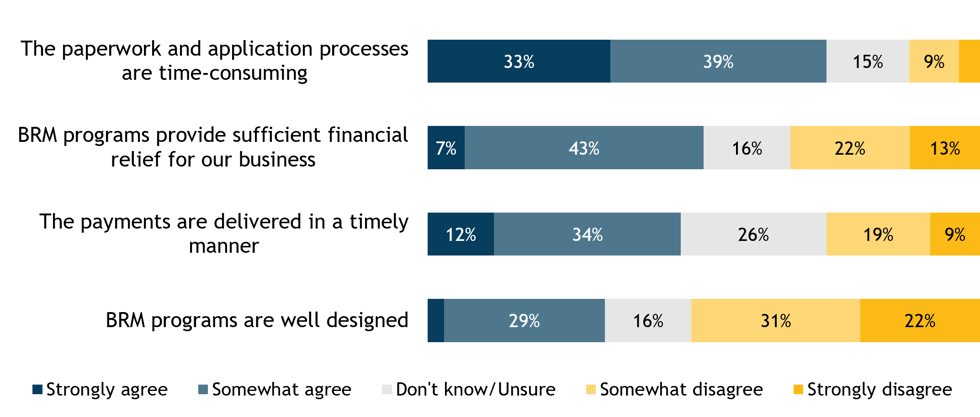
Question: Overall, thinking about your experience with BRM programs in general, please indicate the extent to which you agree or disagree with the following statements.
Source: CFIB, Agriculture Survey, February 11-April 17, 2026, n=133.
The broad concerns highlighted in Figure 1 are reflected in the use and evaluation of individual BRM programs. AgriInvest (71%) and AgriStability (56%) are the two most-used BRM programs among SMEs, and fewer businesses report using AgriInsurance (43%) or the Advance Payments Program (34%). However, high usage does not always translate into positive experiences. While SMEs generally view AgriInvest positively, AgriStability has the highest dissatisfaction rate of the four programs (Figure 2).
Figure 2: Satisfaction varies across BRM programs
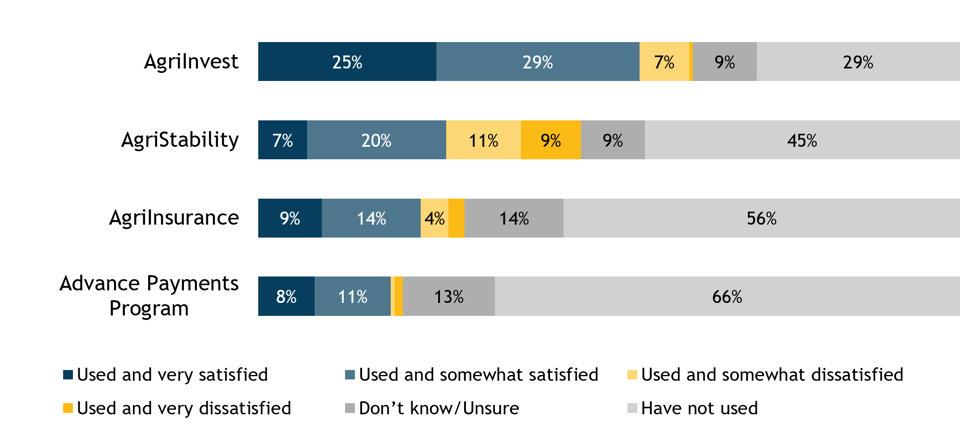
Question: Which of the following BRM programs has your business used in the past three years, and how satisfied were you with your experience?
Source: CFIB, Agriculture Survey, February 11-April 17, 2026, n=175-197 (number of responses varies by program).
The survey results point to several areas where BRM programs are falling short. Difficulty with program design, administrative burden, and payment timelines suggest that many agri-businesses are not receiving the support they need. Specifically, agri-businesses identified three core concerns in their survey responses: red tape, insufficient and unpredictable support, and eligibility gaps.
Red Tape: Complex Applications Create Costly Barriers
Nearly three-quarters (72%) of agri-businesses feel that BRM paperwork and application processes are too time-consuming (Figure 1), causing a significant burden for smaller businesses without dedicated administrative staff.
Time spent filing paperwork is ultimately time diverted from business operations. For example, AgriStability's June 30th application deadline falls during seeding season for many agri-businesses, directing time and resources away from essential farm preparations.
To manage the time constraint, many businesses outsource their BRM applications. This approach can save time, but it often shifts the cost elsewhere. For one agri-business in Saskatchewan, working with an accountant on their AgriStability and AgriInvest applications doubled their accounting bill.
This high cost has dissuaded some from participating in the programs altogether. As one member explained:
"We tried AgriStability, but the benefits appeared to barely cover the administrative costs for paid staff to complete records. AgriInvest has been much the same."
- Livestock Farmer, British Columbia
In addition to time and money, this paperwork also has a human cost: nearly all agri-business owners (95%) report stress related to regulatory requirements.2 In a sector where burnout, anxiety, and depression are already serious concerns, reducing undue stress should be a public policy priority.3
Beyond individual wellbeing, red tape can also discourage young people from taking over or starting an agricultural business. Nearly seven-in-ten (68%) agri-business owners would not advise the next generation to run a business due to the level of red tape—creating concerns about the future of Canada's food supply.4 This would exacerbate Canada’s entrepreneurial drought, as business exits continue to outpace business entries.
These examples show that red tape is exhaustive on all fronts. The time, money, and mental effort spent on BRM applications are limited resources. Streamlining application processes and reducing red tape should be a priority for regulators, both to support productivity and to protect the wellbeing of agri-businesses.
Unpredictable and Insufficient Support: Delayed Payments and Unpopular Program Design
Even when agri-businesses push through the paperwork, help does not always arrive when or how they need it. Fewer than half (46%) of business owners agree that BRM payments arrive in a timely manner (Figure 1). Agri-business owners report waiting months—and in some cases, more than a year—for emergency funding through AgriInsurance and the Advance Payments Program. When experiencing urgent financial pressures, delays of this nature can create serious business instability.
In other cases, the issue is not only timing, but also insufficiency: some agri-businesses report BRM payments falling far below initial estimates, without a clear explanation of why. Complex program standards leave many agri-businesses unsure of their options, and whether it is worthwhile to even apply.
Furthermore, SMEs note that the design of AgriInvest, the most popular BRM program, reduces the value of their deposits and discourages participation. A benefit of the program is that the government matches businesses’ AgriInvest deposits (up to 1% of annual profits), but these matched funds are taxed as income when withdrawn. In addition, participants are required to withdraw all government funding before accessing their own, tax-free savings. When responding to revenue declines or planning for operational investment, this tax burden can complicate businesses’ financial planning.
Over the years, delayed payments, uncertain benefit levels, and taxation have weakened confidence that BRM programs will address agri-businesses’ needs. For BRM programs to serve as a strong safety net, agri-businesses need confidence that support will be timely, predictable and worthwhile.
Eligibility Gaps: Current Rules Leave Some Agri-Businesses Without Support
For some businesses, the problem begins with program eligibility. Current BRM eligibility rules do not always accommodate mixed-farm operations which produce multiple commodities, supply-managed operations, or agri-businesses which sell to other businesses rather than the retail market.
AgriStability illustrates this issue. As the program uses a whole-farm approach (i.e., it requires a 30% revenue decline across the entire business to trigger support), losses in a single commodity or sector of operations may not be enough to qualify for assistance. Several SMEs argued that this approach favours large monocropping operations and discourages diversification.
Similar concerns were raised about program exclusions. Agri-businesses producing supply-managed and non-retail commodities described challenges accessing support for portions of their operations:
"Only got some relief to buy hay during a drought; the heifers were applicable, but not the milk cows."
- Livestock Farmer, British Columbia
A tree farmer affected by the downturn in Canada's forestry industry shared a similar experience, reporting that only 1% of their operations qualified for support, as most of their output is purchased by logging businesses for reforestation purposes. For businesses facing significant financial losses, distinctions such as these can make support appear disconnected from operational realities—leaving some without meaningful support.
Recommendations
BRM programs play an important role in supporting Canadian agriculture, but they require significant reform to ensure that all agri-businesses can benefit. The following recommendations outline how governments can reduce unnecessary barriers and provide a fair, practical safety net for smaller participants:
- Simplify BRM application processes and funding requirements to support agri-businesses with lower administrative capacity.
- Eliminate income tax on withdrawals from AgriInvest accounts.
- Align filing deadlines with regional production schedules or provide greater flexibility, as placing deadlines during busy periods can increase reliance on external services.
- Establish remedies for delays that exceed stated service standards.
- Provide greater transparency regarding compensation formulas and target processing timelines to ensure that agri-businesses can better assess their funding options.
- Shorten processing and payment times for emergency funding programs.