



November 2026 Results
Key takeaways
-
Small business long-term optimism increased to 57.3;
-
Short-term optimism remained unchanged at 45.9;
-
Price increase plans remain at 2.9% - an elevated level.
Small business optimism in Canada
CFIB’s Business Barometer® long-term index, which is based on 12-month forward expectations for business performance, increased by six points to 57.3. The short-term optimism index, based on a 3-month outlook, remained unchanged at 45.9. The large difference (11 points) between long term and the short-term optimism points to a hopeful economic future but a very challenging current environment.
Provincial picture
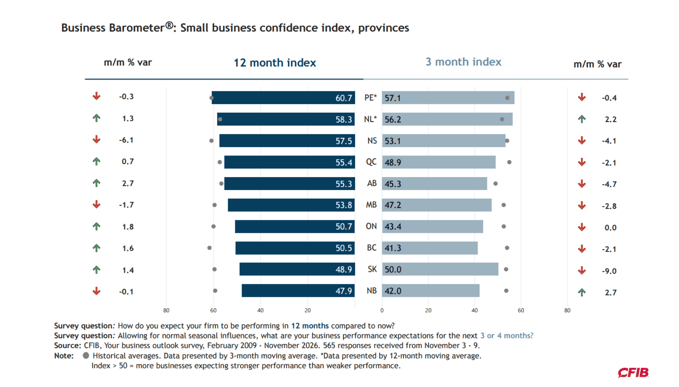
Provincial trends—calculated as three‑month moving averages—range from below 50 in Saskatchewan and New Brunswick to the high 50s in PEI, Nova Scotia, and Newfoundland and Labrador. The four largest provinces have seen small improvements in long term optimism and are sitting around the 50 to 55 mark.
Sectoral overview
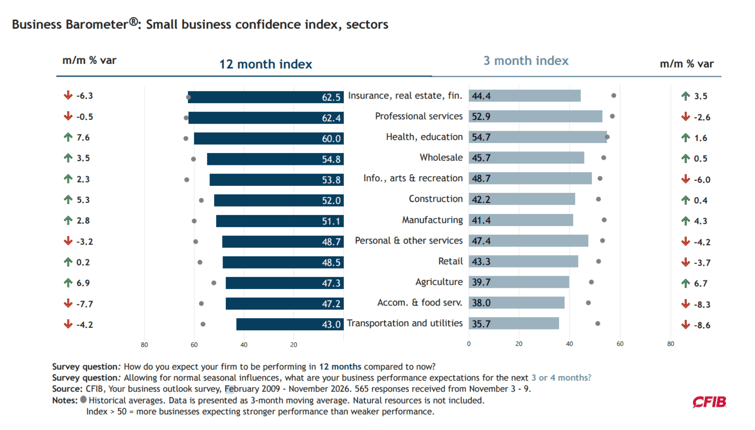
Sectoral confidence—also calculated as three‑month moving averages—remains weakest in agriculture, food and accommodation, and transportation; posting the lowest readings both on the long term and the short term horizons. Retail expectations are very modest for this time of the year, with a long-term optimism index reading of 48.5. Construction, and manufacturing recovered some of the confidence lost in the previous months, jumping just above the 50 mark.
State of business health
The balance of opinion on the current state of business health dropped very slightly to 19 in November, very shy of its historical average.
Inflation indicators
The average price increase edged up to 2.9% in November. The average wage increase sits at 2.4%, an almost unchanged reading from previous months. For more details about price and wage plans, click here.
Other indicators
Full-time staffing plans planned for the next 3-4 months remain weak in November, with a higher share of employers planning to lay off staff (14%) than to hire (12%). This marks for fourth consecutive month of negative hiring plans.
Insufficient demand remains the top constraint to business and production expansion, cited by 52% of SMEs, followed by the shortage of skilled labour (40%). However, the share of firms reporting labour shortages has been declining since its mid year peak.
Fuel costs ranked again as the top cost constraint again and have remained elevated since their peak in April 2026. Product input and material costs registered an increase – 45% of small firms are reporting it as main cost constraint. Borrowing costs also increased, not surprisingly after the recent rate increase announced by the Bank of Canada.
Methodology
These results are based on 565 responses received from November 3rd to 9th from a stratified random sample of CFIB members to a controlled-access web survey. Findings are statistically accurate to +/- 4.1 per cent 19 times in 20.
Every new month, the entire series of indicators is recalculated for the previous month to include all survey responses received in that previous month. Accordingly, October results were recalculated to include 16 additional responses beyond the 301 originally used.
Measured on a scale between 0 and 100, an index below 50 means owners expecting their business’s performance to be weaker over the next three or 12 months outnumber those expecting stronger performance.
Since February 2026, the survey includes two new data points on shipping and receiving costs; and on shortages of equipment and technology.
As of April 2026, our industry codes align fully with NAICS, resulting in slight composition changes in agriculture, natural resources, transportation, and health and education. Questions? Contact us directly.
More details
Regional data about business optimism, price plans, limitations and cost constraints:
The Business Barometer, 2025 Retrospective.